Guria
A small western region by the sea: tea, citrus, the light red wine Chkhaveri.
Guria is the smallest of Western Georgia's regions, wedged between Adjara, Imereti, Samegrelo and the Black Sea; its administrative centre is Ozurgeti. From the 16th century until 1829 it was the semi-independent Principality of Guria, ruled by the Gurieli dynasty, before being absorbed into the Russian Empire.
In February–March 1905, Gurian peasants formed one of the Russian Empire's first “peasant republics” (with elected committees and its own courts), known as the Gurian Republic, which survived until tsarist troops suppressed it in early 1906.
The region is known for Gurian polyphonic singing with its distinctive high falsetto krimanchuli, the ancient ball game lelo burti, and tea cultivation; Georgia's first tea plantations were laid out in Guria in the 19th century.
Sources do not single out a costume unique to Guria alone: the men's “chakura” outfit (a short, waist-length chokha, wide trousers and a colourful silk belt) was shared across Guria, Adjara, Samegrelo and south-western Georgia generally.
Gurian and Adjaran costumes used lighter fabrics and brighter colours than those of eastern Georgia, along with rich silver-thread embroidery.
What to see
- NabeghlaviThe village of Nabeghlavi lies in the mountains of Chokhatauri municipality in Guria, and anyone who has been to Georgia knows its name: it is one of the two best-known Georgian mineral waters. The spring was found in 1905, and according to the local story it was first singled out by buffaloes, which were drawn to this particular water. The water is a sodium-calcium bicarbonate and naturally sparkling: carbon dioxide saturates it at a depth of two to three thousand metres as it passes through the layers of rock. In 1958 a health resort opened here and bottling for sale began, and since 1997 the water has been produced by a Georgian-Swiss company that became the market leader. A bottle of Nabeghlavi turns up on every Georgian table, while the village itself remains a quiet mountain resort.
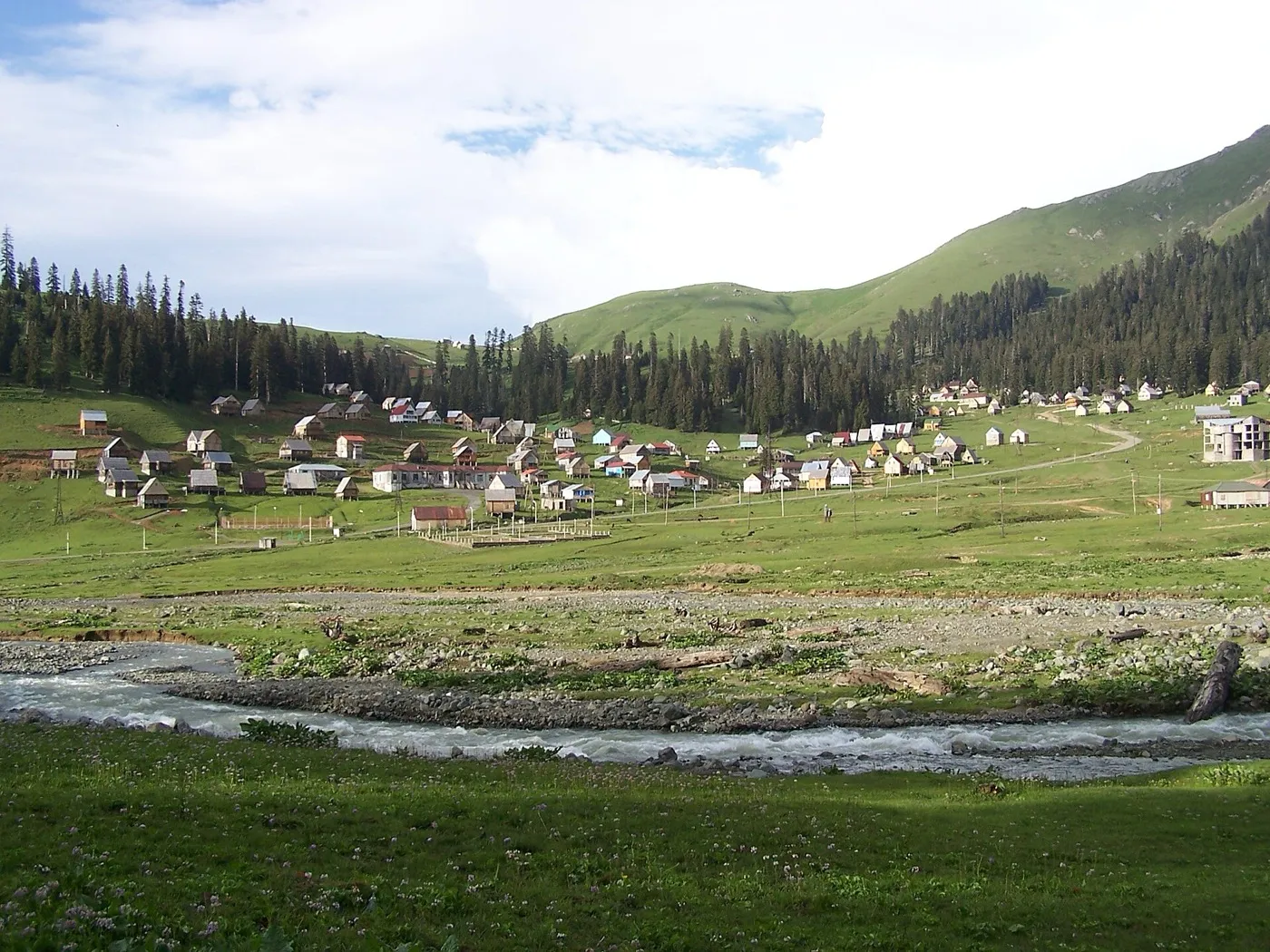
- BakhmaroBakhmaro lies at about 1,950 metres in Chokhatauri municipality in Guria, in a valley among spruce forests, with peaks of 2,300 to 2,700 metres all around. It has been known as a resort for about a century and a half, and its secret is the air: sea air rises here from the coast and mixes with mountain air, and locals are sure that twenty-one days in Bakhmaro heal the lungs and the nerves. The season is short, roughly June to October, and the rest of the year snow buries the road, so people come on foot or on horseback along trails of nearly thirty kilometres. Wooden summer houses on stilts, mists that settle into the valley in the evening and sunrise above the clouds make Bakhmaro Guria's best-known mountain resort, and summer festivals with horse races draw visitors from all over Georgia.
- The plane tree garden in OzurgetiThe Plane Tree Garden occupies the very centre of Ozurgeti, the capital of Guria, and its history is older than its present trees. On this spot lay the garden of the rulers of Guria: according to local tradition, it was in the garden of Prince Mamia V Gurieli that the first tea bushes in Guria appeared in 1809, and later the garden was looked after by the Scot Jacob Marr, who settled in Guria and did much for the local tea growing. In the 1930s, when the town was called Makharadze, paths cut the garden into several parts and plane trees were planted, and since then it has been called the Plane Tree Garden. Today century-old plane trees shade the paths and the benches by the fountains, the Cathedral of the Dormition and a war memorial stand in the middle of the garden, and in the evening the whole town gathers here.
- UrekiUreki lies on the Black Sea coast of Guria, about sixty kilometres north of Batumi, almost at the water's edge, just four metres above the sea. Unlike most beaches on the Georgian coast, it has sand rather than pebbles, and unusual sand at that: black and magnetic, mixed with magnetite. Healing powers are attributed to it, especially for the heart and blood vessels, and in Soviet times sanatoriums grew up along the shore where people came to be treated with the sand. The resort's name means deep forest in Georgian: the whole area was once covered with woods, and today pine groves separate the beach from the village. Ureki became a town in 1953; about a thousand people live here year-round, and in summer the population multiplies with holidaymakers.