Abkhazia
An autonomous republic in the north-west with a subtropical Black Sea coast. Currently outside Tbilisi's effective control.
Abkhazia occupies the country's north-west: a narrow strip of subtropical Black Sea coast rising into the foothills and glaciers of the Greater Caucasus; its capital is Sukhumi. The Abkhaz (Apsua) speak Abkhaz, a language of the Northwest Caucasian family unrelated to Georgian.
During the Soviet period it existed as the Abkhaz ASSR within the Georgian SSR. Georgia, the United Nations and the overwhelming majority of the world's states (189 of the UN's 193 member states) regard Abkhazia as an inseparable part of Georgia's sovereign territory, occupied by Russia: first after the 1992–1993 war and then as a result of Russia's August 2008 invasion. The self-proclaimed authorities in Sukhumi, in power since 1999, are recognised as independent by only four UN member states: Russia, Nicaragua, Venezuela and Syria. Nauru, which recognised Abkhazia in 2009, withdrew its recognition in July 2026.
The region is known for its subtropical landscape (humid Colchic forests and tea and mandarin plantations), as well as Lake Ritsa and one of the world's largest karst cave systems at New Athos.
Like other Caucasus peoples, Abkhaz men's dress was built around the chokha (cherkeska), a fitted black coat with gazyri cartridge pockets sewn across the chest, worn over a shirt, with a beshmet underneath, a felt burka cape for horsemen and a bashlyk hood.
Women's costume consisted of a dress with an open under- or over-coat, underskirts and a belt, often decorated with silver, a tradition shared with the other Abkhaz-Adyghe peoples of the North-West Caucasus.
What to see
- The Sukhumi waterfrontThe Sukhumi embankment runs along the bay in the centre of Abkhazia's capital, and for a long time it was one of the most elegant seaside boulevards on the Black Sea: palms, magnolias, cafés on stilts and piers reaching out into the sea. Sukhumi grew on the site of the Greek colony of Dioscurias, and in the 19th and 20th centuries it became a resort where people came for cures from all over the empire and then the whole Soviet Union; sanatoriums and hotels lined the shore, and one of the oldest botanical gardens in the Caucasus worked nearby. The war of 1992–1993 ravaged the city; many pre-war buildings still stand abandoned, and most of the former Georgian inhabitants were forced to flee. Today Abkhazia is outside Tbilisi's control, and from the Georgian side it can only be reached across the Enguri bridge with special permission.
- New Athos MonasteryNew Athos Monastery stands on the slope of Mount Athos above the town of New Athos, a little over twenty kilometres from Sukhumi. It was founded in 1875 by monks of the Russian St Panteleimon Monastery on the holy Mount Athos in Greece, hence its name. The main cathedral, with five domes in Neo-Byzantine style, was ready by 1900, and its walls were painted in 1911–1914; above the monastery rises a fifty-metre bell tower with the refectory in its lower storey. Several more churches and buildings stand around it, and at the foot lie ponds and gardens laid out by the monks. In 1924 the Soviet authorities closed the monastery, and it was returned to believers only in 1994. Today three church bodies claim it, among them the Georgian Church, which regards Abkhazia as its canonical territory.
- New Athos CaveThe New Athos Cave lies deep inside the Iverian Mountain above New Athos. Local people had long known a pit on the slope and called it the bottomless abyss, but the cave was explored only in 1961, when an expedition of four went down, among them Givi Smyr, who set the discovery in motion. Inside lay a huge karst cavity up to 183 metres deep and about two kilometres long, made up of nine great halls, with underground lakes and flowstone. Since 1975 the cave has been open to tourists, and its own underground railway carries them to the halls, a rarity among the world's caves. The halls are lit, and the route passes through the main grottoes. It is one of the most visited sights in Abkhazia.
- Pitsunda CathedralThe cathedral in Pitsunda was built at the end of the 10th century by Bagrat III, the same king who raised Bagrati in Kutaisi, and it is dedicated to the Apostle Andrew. It stands on the cape where the Greek city of Pityus lay in antiquity, among the relict pine grove that gave the place its name. It is a large church, thirty-seven metres long and twenty-nine high with its dome, built in alternating courses of stone and brick in the late Byzantine manner; inside survive paintings of the 13th and 16th centuries. A 12th-century Georgian Four Gospels was found here in 1830 and is now kept at the National Centre of Manuscripts in Tbilisi. In 1975 an organ by the German firm Schuke was installed in the cathedral, and concerts are held there. The church is now used by the uncanonical Abkhazian Church, which the Georgian Church disputes.
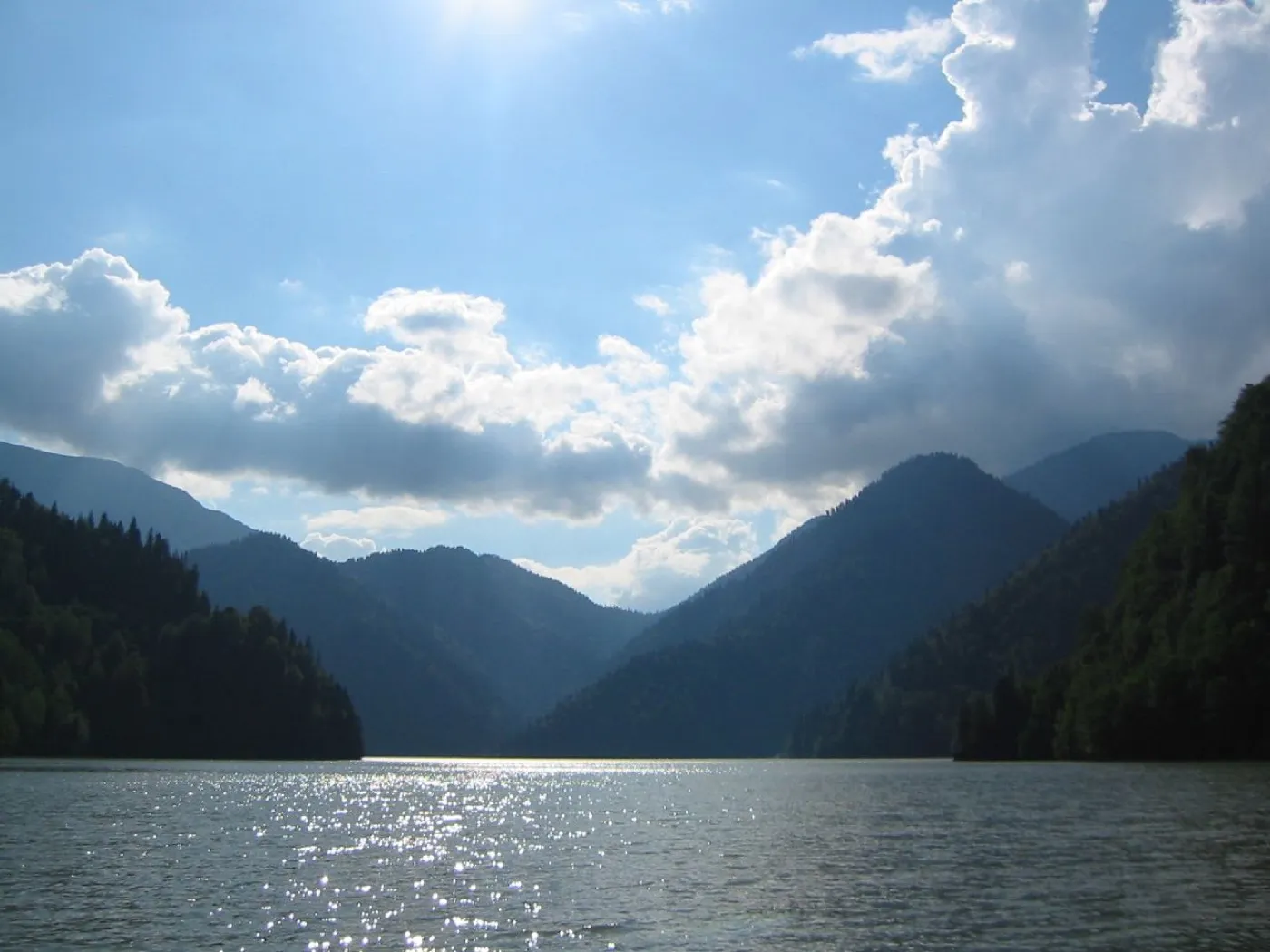
- Lake RitsaLake Ritsa lies at 950 metres in the mountains of north-western Abkhazia, among peaks of 2,200 to 3,500 metres. It is the deepest lake in Abkhazia, up to 116 metres, with an area of about one and a half square kilometres; six rivers feed it, and the Iupshara flows out of it. Mixed mountain forests and subalpine meadows surround it, Nordmann firs here grow more than seventy metres tall, and evergreen box groves fill the gorges. As early as 1930 the Ritsa Nature Reserve of about 163 square kilometres was created here. Stalin had a summer dacha on the shore, and later Brezhnev had one here too. The colour of the water changes with the seasons, from blue to greenish, and Ritsa remains Abkhazia's best-known natural site.