Ananuri Fortress
A 16th–17th-century castle complex on the Georgian Military Road, with churches and towers, seat of the Aragvi eristavi.
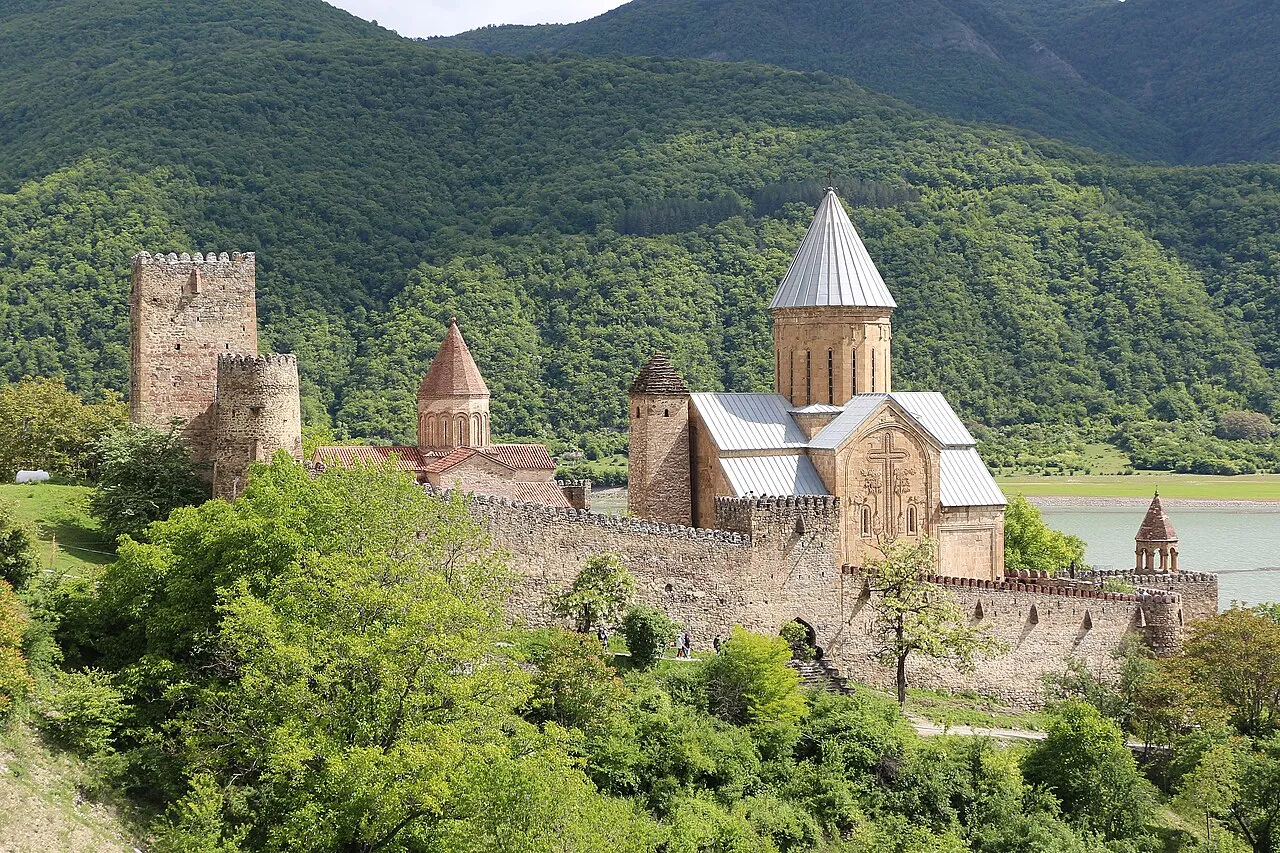
Ananuri lies on the Aragvi, a little over seventy kilometres north of Tbilisi, where the Georgian Military Road climbs into the mountains. From the 13th century these lands were ruled by the eristavis, the dukes, of Aragvi, and the fortress was both their home and their checkpoint: whoever held Ananuri held the road across the Caucasus.
The present complex took shape in the 16th and 17th centuries. Within the walls of the upper fortress rise two churches: a small brick one from the first half of the 17th century and the large Church of the Dormition, built in 1689 for the son of Duke Bardzim. Its façades are covered in carving. A great grapevine cross fills the south wall, a tree of life the back wall, and inscriptions in the ancient asomtavruli script run across the stone.
In 1739 the fortress was stormed by a rival of the Aragvi dukes, Shanshe of Ksani. Ananuri was set on fire and the ducal family massacred. Four years later the peasants rose against their new masters and invited King Teimuraz II to rule, and the fortress stayed in use until the beginning of the 19th century.
Today the Zhinvali Reservoir spreads at the foot of the walls, and Bernard Gagnon's photograph of 2024 catches exactly that: towers above the water, as if the fortress had always stood on a lakeshore. Since 2007 Ananuri has been on UNESCO's tentative World Heritage list, and for most travellers it is the first stop on the road to Kazbegi, where history meets the mountains.