Coin from the reign of Queen Tamar
A copper coin bearing the name of Queen Tamar (1184–1213) — evidence of the unified kingdom's economic and political power.
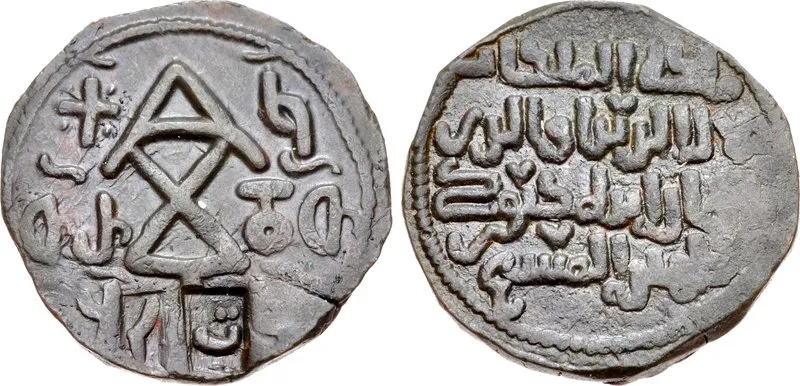
This copper coin, a fals of the Tiflis mint, was struck in 1200. The date is given in the Georgian Paschal cycle, the koronikon: year 420. Tamar ruled from 1184 to 1213 and was the first woman to reign in Georgia in her own right rather than for a husband or son, and charters styled her not queen but king, mepe.
One side bears a large emblem resembling a standard or an upright crossbow, flanked by the letters of a monogram, Tamar and David: the names of the queen and her second husband, David Soslan. The other side carries her titles in four lines of Arabic script: queen of queens, glory of the world and the faith, Tamar daughter of Giorgi, champion of the Messiah.
Arabic on the coin of a Christian queen is no contradiction but calculation. Coins travelled along the trade routes of the Near East, where an Arabic legend could be read by all, and no Georgian coin before Tamar had carried such grand titles. It shows how high the kingdom had risen, its influence reaching from the Black Sea to the Caspian.
This specimen also bears countermarks, small stamps with letters added later, which show that the coin passed from hand to hand for a long time. A copper disc less than three centimetres across holds the whole Golden Age: Georgian letters, Arabic script, trade and power.