Imereti
A central-western region around Kutaisi; the Gelati and Bagrati monasteries, imeruli cheese and khachapuri.
Imereti is the historical heart of western Georgia, stretching along the middle Rioni valley, from humid subtropics near Guria to alpine meadows almost 2,850 m high on the Racha border. Its capital, Kutaisi, is one of the country's oldest cities and its second-largest urban area.
Karst landscapes meet the golden age of medieval Georgia here: Prometheus and Sataplia caves, Okatse Canyon and, in and around Kutaisi, Bagrati Cathedral and Gelati Monastery, both on the UNESCO World Heritage List.
Imeretian cuisine and winemaking form their own school: imeruli khachapuri, sulguni cheese, light qvevri wines from Tsolikouri and Tsitska grapes, and the Sviri appellation.
Unlike Adjara or Svaneti, sources do not single out a separately documented costume tradition for Imereti: men wore the general Georgian chokha and women a long dress with an apron, the base ensemble typical of the lowland provinces of historical Georgia.
Wealthy families sourced silk and brocade through Black Sea trade; cut and embroidery were close to those of the neighbouring lowland provinces of western Georgia.
What to see
- Motsameta MonasteryThe monastery stands on a high promontory above the Tskaltsitela river, six kilometres north-east of Kutaisi, and its name means the place of the martyrs. In the 8th century the brothers David and Constantine Mkheidze led resistance against the Arab army of Marwan the Deaf; when the rising was crushed, they refused to accept Islam and were executed. Legend says that lions carried their bodies up to this hill and that the river turned red with blood after the execution, hence its name, Red Water. In the 11th century King Bagrat IV built a church here, and the brothers are venerated as saints. In 1923 their relics were taken to a museum, but after protests they were returned and are still kept in the monastery. Local legend tells of an underground passage from here to Gelati.
- Gelati MonasteryDavid the Builder began this monastery on a hillside a few kilometres north-east of Kutaisi in 1106, conceiving it as both cloister and school. Around it grew the Gelati Academy, where the philosopher Ioane Petritsi and the theologian Arsen Ikaltoeli worked, and the main Church of the Nativity of the Virgin keeps a 12th-century mosaic: the Virgin and Child between archangels. David himself is buried at the south gate, under a slab that everyone entering must cross, and nearby stand the Gates of Ganja, carried off by his son Demetrius I in 1138. The churches of St George and St Nicholas were added in the 13th century. Since 1994 Gelati has been on the UNESCO World Heritage list, and Georgia's Golden Age is felt here more keenly than anywhere.
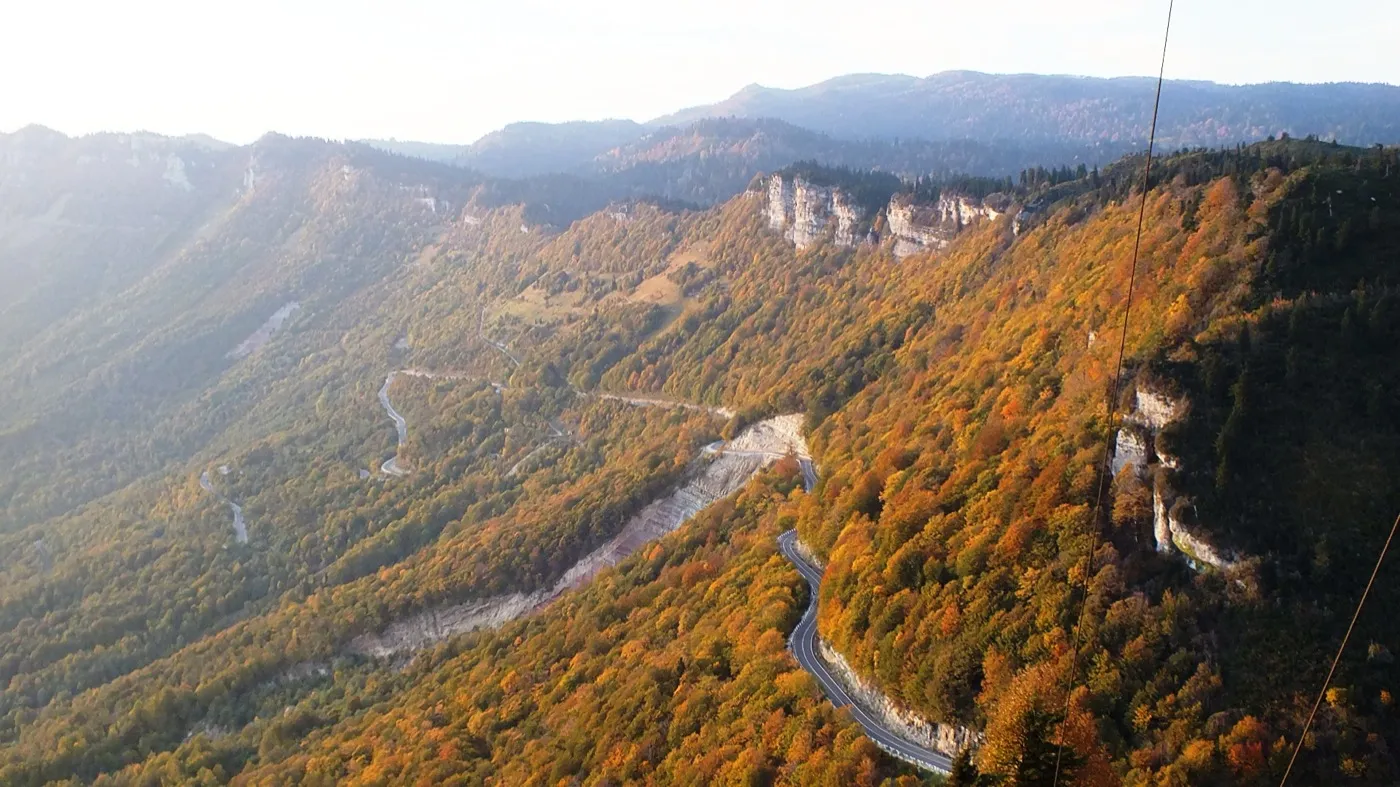
- Tskhradzvari and the abandoned cable carA summit of the Racha range, one thousand five hundred and sixty-five metres, by the Nakerala pass. The name means nine crosses. From the top you see the mining town of Tkibuli with its reservoir, the whole Imeretian plain and the Khvamli massif across the valley. In 1984 the upper station of a cable car was built here to link the summit with the town below: the line did run for a while, but with the collapse of the Union the work was abandoned and part of the structures were taken away for building material. The concrete station still stands in the forest, half an hour along the path from the summit. Photograph by Levan Davlianidze.
- Bagrati CathedralThe cathedral stands on Ukimerioni Hill above Kutaisi and was conceived as the main church of the united kingdom. It was built by Bagrat III, the first king of a united Georgia; an inscription records that the floor was laid in the year 223 of the koronikon, that is, in 1003. In 1692 an Ottoman cannonball brought down the dome and vaults, and for more than three centuries the cathedral stood in ruins. Restoration began in the 1950s under Vakhtang Tsintsadze and ended in 2012 with a reconstruction that caused controversy: in 1994 Bagrati was inscribed on the UNESCO World Heritage list together with Gelati, in 2010 the works put it on the endangered list, and in 2017 it was removed. Today it is a working cathedral and one of Kutaisi's favourite places for weddings.
- Prometheus Cave (Kumistavi)The cave lies beneath the village of Kumistavi near Tskaltubo and was discovered by Georgian speleologists led by Jumber Jishkariani in the early 1980s. The whole karst system runs for about eleven kilometres, with twenty-two chambers and an underground river along its floor, only half of which has been explored. Six chambers are open to visitors: a route of about 1.8 kilometres descends almost eighty metres past stalactites, stalagmites, petrified waterfalls and underground lakes, and at the end you can leave by boat along the river. Work to fit out the cave began in 1985 but stopped with the collapse of the USSR, and it received its first visitors only on 26 May 2011. It was named after Prometheus in memory of the myth that the Titan was chained to the rocks of the Caucasus.
- Okatse CanyonThe Okatse Canyon is cut by the river of the same name near the village of Gordi in Khoni municipality, and in places it is up to a hundred metres deep. The path to it starts in the old forest where the Dadiani princes of Mingrelia hunted, and in 2014 a hanging metal walkway 780 metres long was opened above the chasm itself: it is bolted straight onto the sheer wall, and through the grating underfoot you can see the river. At the end of the walkway a viewing platform juts out over the drop, and from here the whole canyon is in view. A few kilometres away the Okatse waterfall plunges from a ledge, reached by a separate trail. The whole walk takes two or three hours and, together with the Martvili Canyon, makes one of the most popular day trips from Kutaisi.