Samtskhe-Javakheti
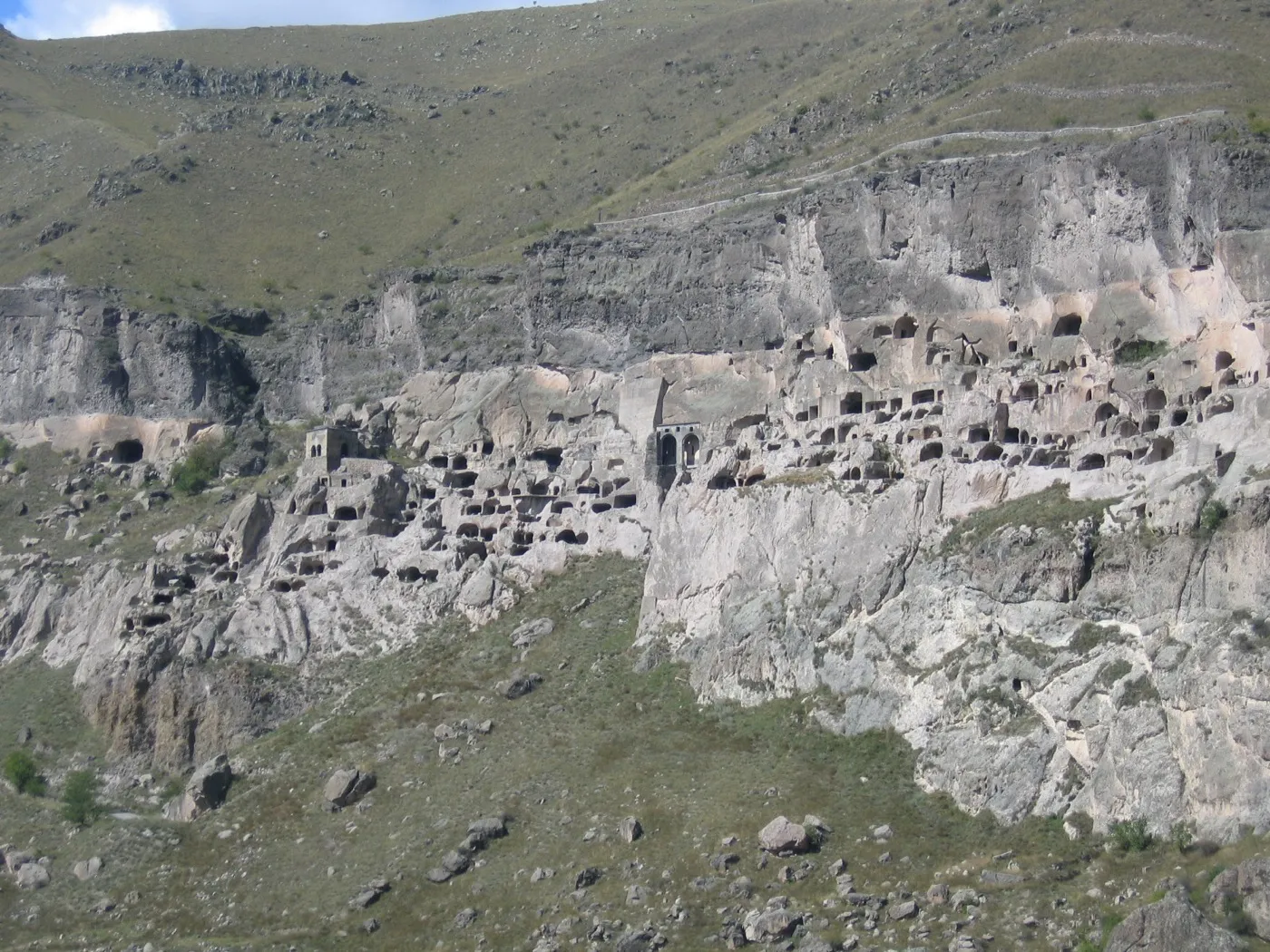
A southern highland; the Rabati fortress, the cave city of Vardzia, the high lakes of Javakheti.
Samtskhe-Javakheti occupies the country's south, on the border with Turkey and Armenia: mountainous Samtskhe (Meskheti) in the west and the volcanic Javakheti plateau in the east, home to Georgia's largest lakes: Paravani, Tabatskuri, Khanchali.
Its administrative centre, Akhaltsikhe (“New Fortress”), is overlooked by the restored Rabati citadel, with a mosque, synagogue and church under one roof, a symbol of the region's centuries of religious diversity.
In Akhalkalaki and Ninotsminda municipalities the overwhelming majority of the population are ethnic Armenians, descendants of settlers from the Ottoman Empire in the early 19th century; the region is also known for the cave cities of Vardzia and Vanis Kvabebi.
Sources describe a distinct, widely documented Meskhetian costume only sparsely; this borderland with Turkey and Armenia wore a variant of the general Georgian costume with noticeable influence from neighbouring cultures in fabrics and trim, but few detailed descriptions have survived.
Javakheti has its own Armenian costume tradition (embroidered dresses, coin-adorned headdresses) brought by early-19th-century settlers and existing alongside the Georgian one.
What to see
- Rabati CastleRabati Castle rises above the Potskhovi river in Akhaltsikhe, and its first name, back in the 9th century, was Lomsia, the lion's. From the 13th to the late 14th century this was the capital of Samtskhe-Saatabago, the domain of the Jaqeli princes. Later the region passed to the Ottomans, and in 1752 the ruler Haji Ahmed Pasha Jaqeli built a mosque in the castle modelled on Hagia Sophia in Constantinople; in 1828, when Russia took Akhaltsikhe, it was turned into a church. Within the walls stand the mosque, a madrasa, baths, an Orthodox church, the Jaqeli castle and the citadel, and a tunnel led down to the river. In 2011–2012 the castle was entirely reconstructed for thirty-four million lari; the work was called controversial, but Rabati has become the main sight of Samtskhe-Javakheti, where you can see Georgian and Ottoman histories meeting in one place.
- Sapara MonasterySapara Monastery hides in a green wooded gorge not far from Akhaltsikhe, and its buildings of pink and yellow stone only come into view at the last bend of the road. The community existed from at least the 9th century, and the oldest church, the Church of the Dormition, was probably built in the 10th. The main church of St Saba was raised in the 13th and 14th centuries under Prince Beka Jaqeli; it is called the finest example of church architecture of its time, and the name of the architect Peresasdze is carved on the arch of the west window. Inside survive high-quality 14th-century frescoes: Gospel scenes, saints and portraits of the Jaqeli rulers Sargis I, Beka I, Sargis II and Kvarkvare. At the end of the 16th century, with the arrival of the Ottomans, the monastery was emptied and its icons and treasures taken to safer places; today monks live here again.
- Khertvisi FortressKhertvisi Fortress stands on a rock at the confluence of the Mtkvari and the Paravani, at about 1,250 metres, in Aspindza municipality, and it is one of the oldest fortresses in Georgia. The present walls, according to an inscription, were raised in 1354, and the fortress itself was built, it seems, in the 10th and 11th centuries on the site of an even older stronghold; legend traces its beginnings to the time of Alexander the Great. Khertvisi barred the road to Javakheti and Vardzia and so changed hands for centuries. When Georgian troops briefly retook it from the Ottomans in 1771, King Erekle II ordered valuables and goods to be carried away, which suggests that there was once not just a village here but a rich town. Today about two hundred people live in the village at its foot.
- Vardzia cave cityThe cave monastery is cut into the slope of Mount Erusheti above the Mtkvari, at about 1,300 metres, and runs along the cliff for almost half a kilometre in up to nineteen tiers. Giorgi III began it in the late 12th century and his daughter, Queen Tamar, enlarged it: some five hundred caves held cells, churches, bakeries, forges and a hundred and eighty-five wine jars, and water came through an aqueduct three and a half kilometres long. The Church of the Dormition keeps frescoes of 1184–1186 with portraits of Giorgi and the young Tamar. The earthquake of 1283 badly damaged the monastery, and in 1551 the troops of Shah Tahmasp sacked it. Legend says that the child Tamar, lost here, answered her uncle "Ak var, dzia", "I am here, uncle", and so the place got its name. A monastic community still lives here today.