Shida Kartli
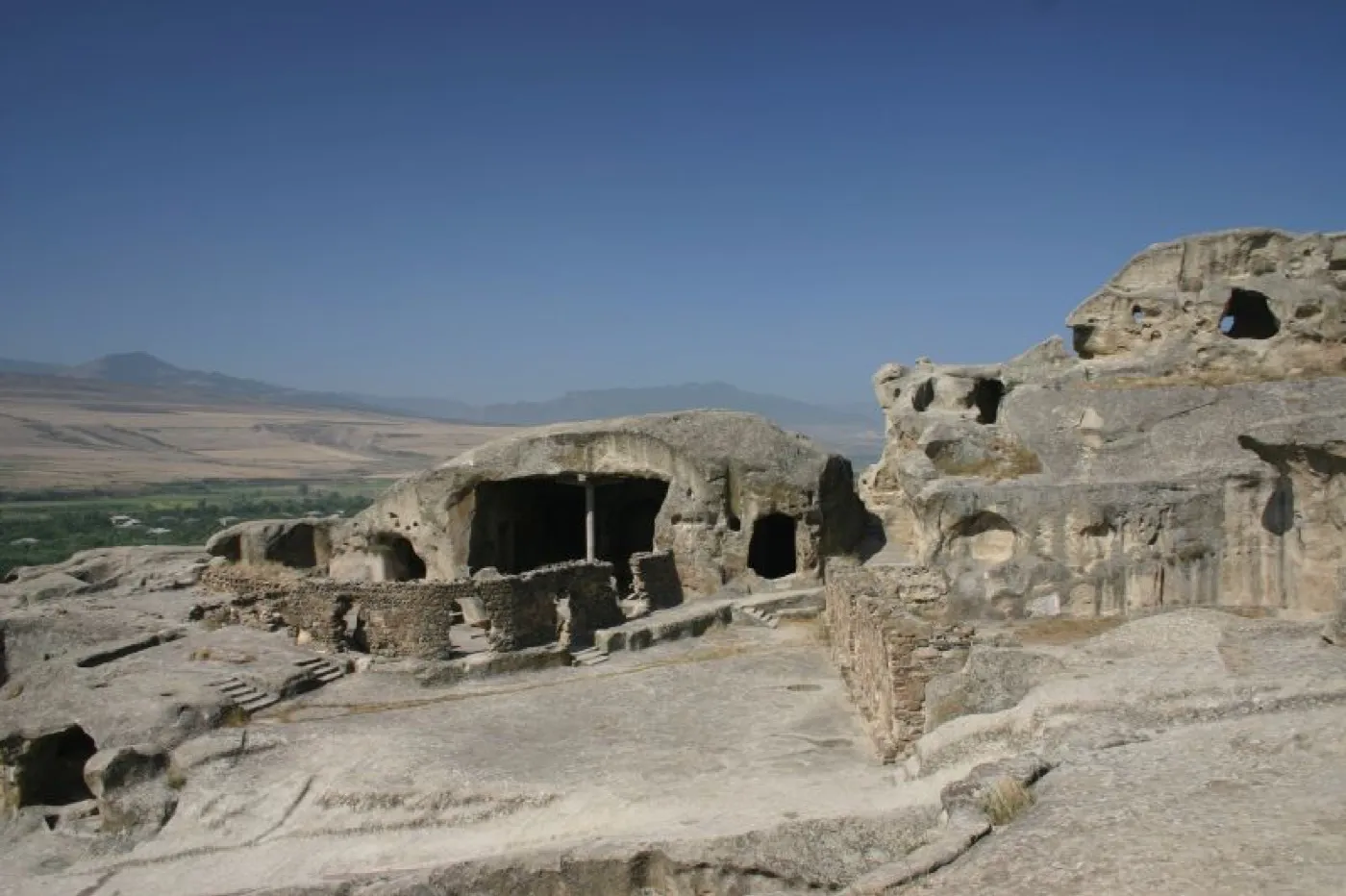
Inner Kartli in the country's centre; the rock town of Uplistsikhe, Gori. Part of it (Tskhinvali) is outside Tbilisi's control.
Shida Kartli (“Inner Kartli”) is a central region on both banks of the Mtkvari at the foot of the Trialeti and Caucasus ranges; its administrative centre, Gori, is Georgia's fifth-largest city.
The region was the political and spiritual heart of ancient Kartli: the cave city of Uplistsikhe was already active in the Bronze Age, and the 7th-century Ateni Sioni church holds the earliest known examples of both Georgian scripts, Nuskhuri and Mkhedruli.
Since 1992 the region's northern part (Java Municipality and parts of Kareli and Gori municipalities) has been under the control of the authorities of the self-proclaimed Republic of South Ossetia. In August 2008 the Russo-Georgian war passed through Shida Kartli: Gori was bombed and held for several days, and tens of thousands left the villages along the line. The administrative boundary line runs across the region and has crept further inland over the years, cutting villages off from their fields and orchards.
Sources do not single out a separately documented Shida Kartli costume tradition, unlike mountainous Khevsureti or Svaneti: the region, neighbouring the capital, wore the general lowland Kartli costume: a chokha for men, a katibi dress for women.
What to see
- UplistsikheThe town is carved straight into the rock on the left bank of the Mtkvari, ten kilometres east of Gori, and its very name means the lord's fortress. People lived here from the end of the 2nd millennium BC, and the first rock-cut buildings appeared at the beginning of our era, when Uplistsikhe was one of the chief political and pagan centres of Kartli. Across eight hectares survive streets, stairways, a pillared hall with stone benches and a tunnel down to the river that kept the town supplied with water. With Christianity came a 6th-century basilica, and on the summit rose a three-church basilica of the 8th to 10th centuries: while the Arabs held Tbilisi, Uplistsikhe again became a mainstay of the Georgian kings. Mongol raids in the 14th century emptied the town for good, and it has stood deserted ever since, a stage set of ancient Kartli frozen in stone.
- Gori FortressThe fortress stands on a rocky hill above Gori, and from its walls the whole town and the Mtkvari valley are in view. There was a fortification here already in the last centuries BC, and the fortress appears in written sources from the 13th century. It took its present form under King Rostom of Kartli in the 1630s, who stationed an Iranian garrison here, and under Erekle II in 1774; around 1642 the Italian missionary Cristoforo Castelli drew it, and his sketch remains a valuable record. Its commanding position allowed control of the trade routes, so a strong garrison was always kept here. In 1920 an earthquake badly damaged it; the best-preserved part is the western section, Tskhra-kara, the Nine Gates. At the foot of the hill stands a memorial to those killed in the 2008 war.
- Stalin Museum, GoriThe museum in the centre of Gori was officially dedicated to Stalin in 1957 and has three parts. The first is the small wooden house where Ioseb Jughashvili was born in 1878: the family lived and the shoemaker father worked in one room, the landlord in the other; a pavilion in Greco-Italian style was built over it. The second is a large building in the Stalinist Gothic style, begun in 1951, with halls where personal belongings, office furniture, gifts and photographs are laid out in order. The third is an armoured Pullman carriage weighing 83 tonnes, in which Stalin travelled from 1941. After the 2008 war there were proposals to turn it into a museum of Russian aggression, but in 2012 the town assembly dropped the idea, and the debate over how to tell the story of Stalin's repressions here has never died down.
- Ateni Sioni ChurchThe church stands in the village of Ateni, ten kilometres south of Gori, in the picturesque gorge of the Tana river, famous not only for its antiquities but for its wine. It was built in the early 7th century on the model of Jvari in Mtskheta: it is the same four-apsed type, and scholars count it among the Jvari group. An Armenian inscription names a master called Todosak, though it is debated whether he was the first builder or a 10th-century restorer. Inside survive 11th-century frescoes painted by at least four artists, luminous, in blues, greys and violets. But Ateni's greatest treasure is the writing on its walls: among it are nuskhuri inscriptions of 835 and the earliest known examples of mkhedruli from the 980s, the very script Georgians write in today.
- Surami FortressSurami lies on the southern slopes of the Likhi range, four kilometres from Khashuri, where, at the mouth of the Borjomi gorge, the road passes from eastern Georgia into the west. There was a settlement here as early as the Bronze Age, and this may be the Surium mentioned by Pliny the Elder. From the 12th century the fortress guarded this pass and therefore changed hands again and again. It is linked to the legend of a youth walled up alive so that the wall would stop collapsing; in 1859 Daniel Chonkadze retold it in a novella, and in 1985 Sergei Parajanov made it into the film The Legend of Suram Fortress. Today ruins remain on a hill above the town, and Surami itself, with about seven and a half thousand people, is known as a mountain climate resort.