Mtskheta-Mtianeti
From the ancient capital Mtskheta (Svetitskhoveli, Jvari) to the highlands of Kazbegi and Khevsureti.
Mtskheta-Mtianeti unites Georgia's oldest capital with high mountain country, from Mtskheta at the confluence of the Mtkvari and Aragvi to the snow-capped peaks of Kazbegi on the Russian border. The historical territory covers Khevi, Pshavi, Khevsureti, Mtiuleti and Gudamakari.
Mtskheta was the capital of the Kingdom of Iberia from the 3rd century BC and remains the country's spiritual centre, where Georgian kings were crowned and buried; Mtskheta's churches are on UNESCO's World Heritage List.
Mountainous Khevsureti and Pshavi lived for centuries almost independently of the rest of Georgia, preserving unique stone fortress-tower architecture, local dialects and pre-Christian customs interwoven with Orthodoxy.
The costume of highland Khevsureti and Pshavi is one of the most recognisable in Georgia. The women's sadiato dress was knee-length, decorated with beadwork and intricate geometric appliqué; headdresses bore cross-shaped patterns, while Pshav women wore a tavchita headdress adorned with silver coins and crosses.
The Khevsur men's chokha was short and trapezoid-shaped, richly decorated with crosses and icons on the chest and with side slits to the waist. In Pshavi, men and women alike wore a shared woollen garment called juba; underneath it, women wore a shirt and an elongated jacket, the sagule.
What to see
- Jvari MonasteryThe monastery stands on a rocky hill above the confluence of the Aragvi and the Mtkvari, opposite Mtskheta. Tradition holds that in the early 4th century St Nino raised a great wooden cross here, on the site of a pagan sanctuary, and that it worked miracles and drew pilgrims from all over the Caucasus. Around 545 a small church was built over it, and in 590–605 the erismtavari Stephanos I raised the great church; beneath the dome you can still see the pedestal within an octagonal enclosure where the cross stood. The four-apsed church with niches between its apses became the model for many Georgian churches, and its façades carry reliefs of the donors before Christ. Jvari is often named as the prototype of the monastery in Lermontov's Mtsyri, though there is no consensus. Since 1994 it has been on the UNESCO World Heritage list among the Historical Monuments of Mtskheta.
- Svetitskhoveli CathedralThe cathedral stands in the centre of Mtskheta, the ancient capital of Kartli, and for many centuries was Georgia's principal church. The present building was raised in 1010–1029 by the architect Arsukisdze for Catholicos Melchizedek, and before it the site held a 4th-century wooden church built under King Mirian and a 5th-century basilica of Vakhtang Gorgasali. The name means the life-giving pillar: according to the hagiography, Elioz brought the Robe of Christ from Jerusalem, his sister Sidonia died clasping it to her breast and was buried with it, and the columns of the first church were hewn from the cedar that grew on her grave. Kings are buried beneath the vaults, among them Vakhtang Gorgasali, Erekle II and George XII; the stone wall with towers was built by Erekle II in 1787. Since 1994 the cathedral has been on the UNESCO World Heritage list among the Historical Monuments of Mtskheta.
- Ananuri FortressAnanuri stands on the Aragvi, a little over seventy kilometres north of Tbilisi, where the Georgian Military Road climbs into the mountains. From the 13th century these lands were ruled by the eristavis of Aragvi, and the fortress was both their home and their checkpoint. The present complex took shape in the 16th and 17th centuries: within the walls of the upper fortress rise two churches, and the large Church of the Dormition, built in 1689 for the son of Duke Bardzim, is covered in carving, with a great grapevine cross on the south wall and a tree of life on the back. In 1739 the fortress was stormed by Shanshe of Ksani, Ananuri was burned and the ducal family massacred; the fortress remained in use until the early 19th century. Today the Zhinvali Reservoir spreads at the foot of the walls, and since 2007 Ananuri has been on UNESCO's tentative World Heritage list.
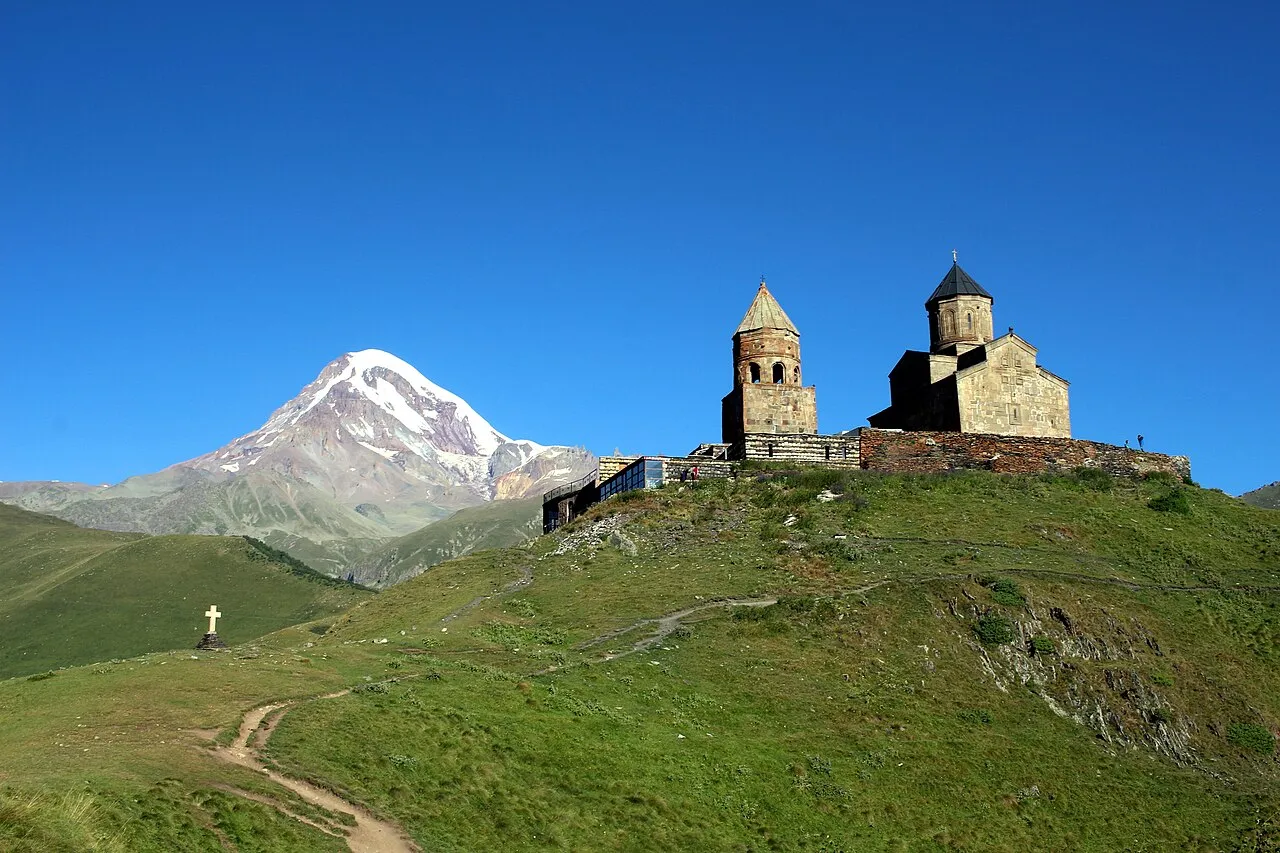
- Gergeti Trinity ChurchThe Trinity Church stands on a spur below Kazbek (5,054 m), at 2,170 metres, above the village of Gergeti and Stepantsminda. It was built in the 14th century, it is the only cross-domed church in Khevi, and beside it rises a separate bell tower of the same period. The height was chosen not for the view: in dangerous times the sacred treasures of Mtskheta were carried up here, beneath the glacier. In 1988 a cable car was run up to the church with its top station right by the walls, and the people of Stepantsminda soon destroyed it, considering it a desecration. Today a footpath, an hour and a half to two hours of climbing, and a road lead to the church, and with Kazbek behind it, it has become perhaps the most recognisable view in Georgia.
- Shatili fortress-villageShatili lies in the deep Arghuni gorge, at about 1,400 metres, on the northern slope of the Greater Caucasus, right by the border with Chechnya, in the heart of historic Khevsureti. Some sixty towers and flat-roofed stone houses have grown together here into a single continuous chain of fortifications, so that the whole village worked as one fortress: you could cross from house to house over the roofs without going down into the street. These lands were once part of the Kingdom of Kakheti. In the early 1950s the Soviet authorities resettled the people of Shatili and most of Khevsureti to the plains, and in the 1960s the empty village became a set for Georgian films about the highlanders' past. Today about twenty people live here, snow closes the road over the pass in winter, and Shatili is on UNESCO's tentative World Heritage list.