Kvemo Kartli
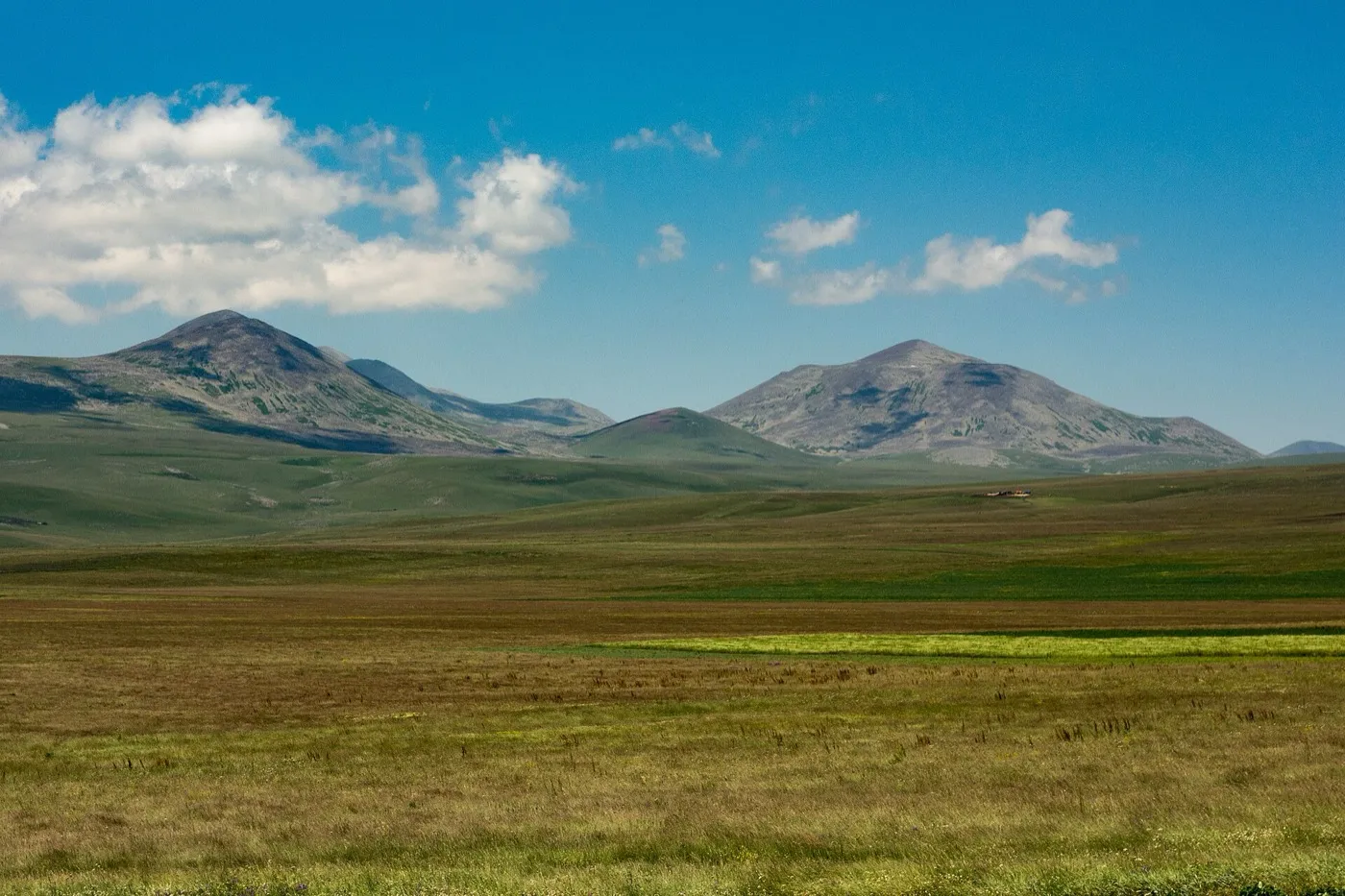
The south-east by the Armenian and Azerbaijani borders; Dmanisi (the earliest hominins), the David Gareja monastery.
Kvemo Kartli is an open, arid plain in the country's south-east, along the borders with Armenia and Azerbaijan; after Tbilisi it is Georgia's second-ranked region by industrial output. Its administrative centre, Rustavi, is Georgia's fourth-largest city, planned in the 1940s around a metallurgical plant.
The region is Georgia's most multiethnic: ethnic Georgians predominate in the north, Azerbaijanis in the south around Marneuli, Dmanisi and Bolnisi, and Armenians and Greeks have historically lived in Tsalka Municipality.
It is also home to the oldest traces of humans outside Africa (Dmanisi, 1.8 million years) and Bolnisi Sioni, Georgia's oldest dated church (478–493), bearing the earliest inscription in Georgian script.
Kvemo Kartli is Georgia's most multiethnic region, and no single “Kartli costume” exists here: the traditions of different communities coexist side by side. The Azerbaijani population of the south preserves its own folk dress (arkhalig, chepken, kelaghayi headscarves), and the Armenian and Greek communities of Tsalka their own.
Ethnic Georgians in the region wore the general Kartli costume, close to that of Tbilisi and lowland eastern Georgia (a chokha with a set belt for men, a katibi dress for women), without pronounced local distinctions.
What to see
- RustaviRustavi lies on the Mtkvari twenty kilometres south of Tbilisi and today ranks third in Georgia by population, with about 128,000 people. The city has two lives. Ancient Rustavi, a fortress and medieval town on the caravan road, was devastated after Timur's invasion and vanished for a long time. The new city grew up in the 1940s around the Rustavi Metallurgical Plant, built in 1941–1950 to process ore from neighbouring Azerbaijan; among its builders were German prisoners of war. Rustavi became a model Soviet city with broad avenues and Stalin-era blocks, but the collapse of the USSR hit it hard: industry lost two thirds of its workers. Today the city is growing again, and its Rustavi International Motorpark hosts international races.
- Asureti (Elisabethtal)A German colony founded in 1818 by Swabians from Württemberg and named Elisabethtal; under Soviet rule it was renamed Asureti. Straight streets, half-timbered houses, a church consecrated in August 1871, and a surviving German cemetery where one slab reads “Auf Wiedersehen!”. In the autumn of 1941 the Germans were deported and highlanders from Racha were moved into the emptied houses; their descendants live here still. The church was restored in 2020 and now holds an exhibition of photographs. The Shala grape, also called Asuretuli Shavi, comes from here. The full story is in the essay “Asureti: two communities of one village”.
- Bolnisi Sioni CathedralThe Sioni of Bolnisi was built in 478–493 and is considered the oldest surviving church in Georgia. It is the first Georgian building to carry its completion date carved on the wall, and the Bolnisi inscriptions in the ancient asomtavruli script are among the oldest documents of Georgian writing. The three-aisled basilica is built of stone, and its southern and central parts are covered in carving: vine scrolls, arabesques, foliage. The ornament clearly shows links with Sasanian Iran, Armenia and the Near East, for Kartli then lived beside Persia and in constant contact with it. Here too the Bolnisi cross is carved, an equal-armed sign with flaring ends, echoed in 2004 by the four small crosses on the state flag of Georgia.
- Tsughrughasheni ChurchThe church of Tsughrughasheni stands on the right bank of the Bolnisistskali river, a couple of kilometres from the Bolnisi Sioni, and was built in 1212–1222; its builder is said to have been King George IV Lasha, Tamar's son. It is related to the great churches of that age, Betania, Kvatakhevi and Pitareti, but smaller than they are and with a noticeably taller drum, which makes it seem to soar. The façades are covered in fine stone carving with traditional Georgian ornament, the windows and the drum framed especially richly, and inscriptions survive on the west front. The church stands away from the main roads, on a hill among fields, and is rarely crowded, though for the quality of its carving it is ranked with the finest buildings of the Golden Age. Today it is a working church.
- DmanisiDmanisi lies on a promontory between the Mashavera and Pinezauri rivers, and the place has two pasts. On top stand the ruins of a medieval town on the caravan road, with a citadel, baths, a bridge and the cathedral of Dmanisi Sioni. Below them, in deposits of the volcanic era, fossils of the earliest humans outside Africa, about 1.8 million years old, have been found since 1991. Five skulls were found here at once, among them a toothless old man whom someone, it seems, looked after, and Skull 5, the most complete early human skull of its age. These finds forced a rethink of when, and in what form, the first humans left Africa. Today Dmanisi is an open-air museum: a pavilion has been built over the dig, where you can watch the archaeologists at work.