Goristsikhe: the fortress above Gori
A citadel on a rock where the Liakhvi meets the Mtkvari. Whoever held it was master of all Shida Kartli.
1630
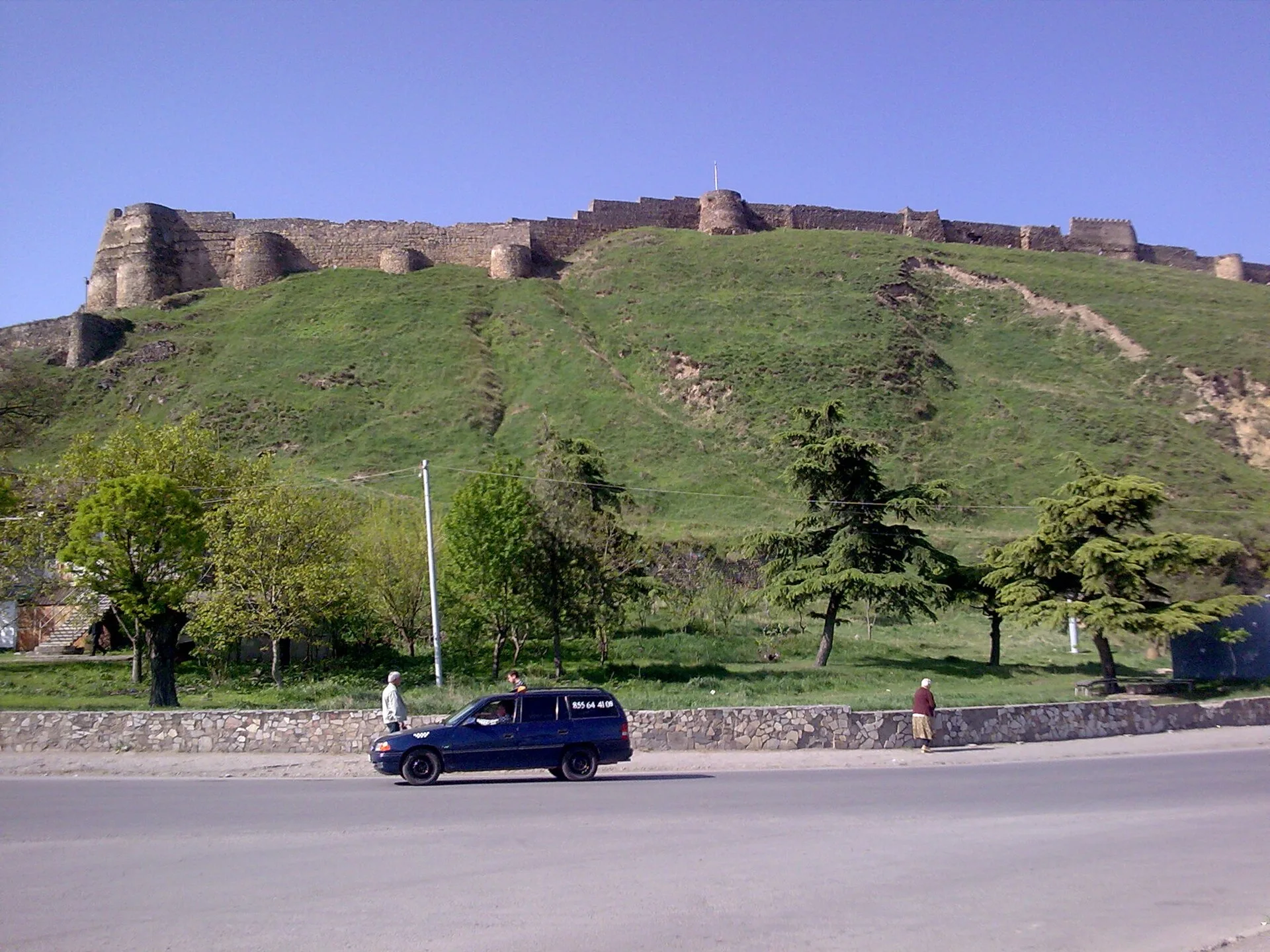
The fortress of Gori stands on a rocky hill in the middle of the town, where the Great Liakhvi meets the Mtkvari. The road from west to east ran along the Mtkvari, a route from the north came down the Liakhvi, and the fortress watched over both. It is first named in written sources in the thirteenth century, but excavations on the northern slope have shown that a strong fortification with a settlement around it existed here in the last centuries BC. To hold Goristsikhe was to be master of all Shida Kartli.
In the sixteenth century the Ottomans seized the fortress. In 1598 King Simon I besieged it for nine months without success, and in 1599 he resorted to a ruse: for Lent the Georgians pretended to lift the siege, then took the citadel in a sudden night assault. In the seventeenth century it passed more than once from Georgians to Persians and back. Most of the present walls were raised in the 1630s by King Rostom, and Erekle II gave the fortress its final form in 1774. Around 1642 it was drawn by the Italian missionary Cristoforo Castelli, who lived in Gori.
After 1801 a Russian grenadier battalion was stationed in the fortress, but it quickly lost its military importance, and by the middle of the nineteenth century only a chapel remained in use. In 1920 an earthquake badly damaged the walls, and in the 1950s they were partly restored. Best preserved is the western part, known as Tskhrakara, that is, the Nine Gates. The walls are built of river cobbles, with dressed stone showing in the earlier layers.