Ateni Sioni: a church with history written on its walls
A seventh-century tetraconch in the gorge of the Tana river, with eleventh-century frescoes and the earliest known inscriptions in the Nuskhuri and Mkhedruli scripts.
650
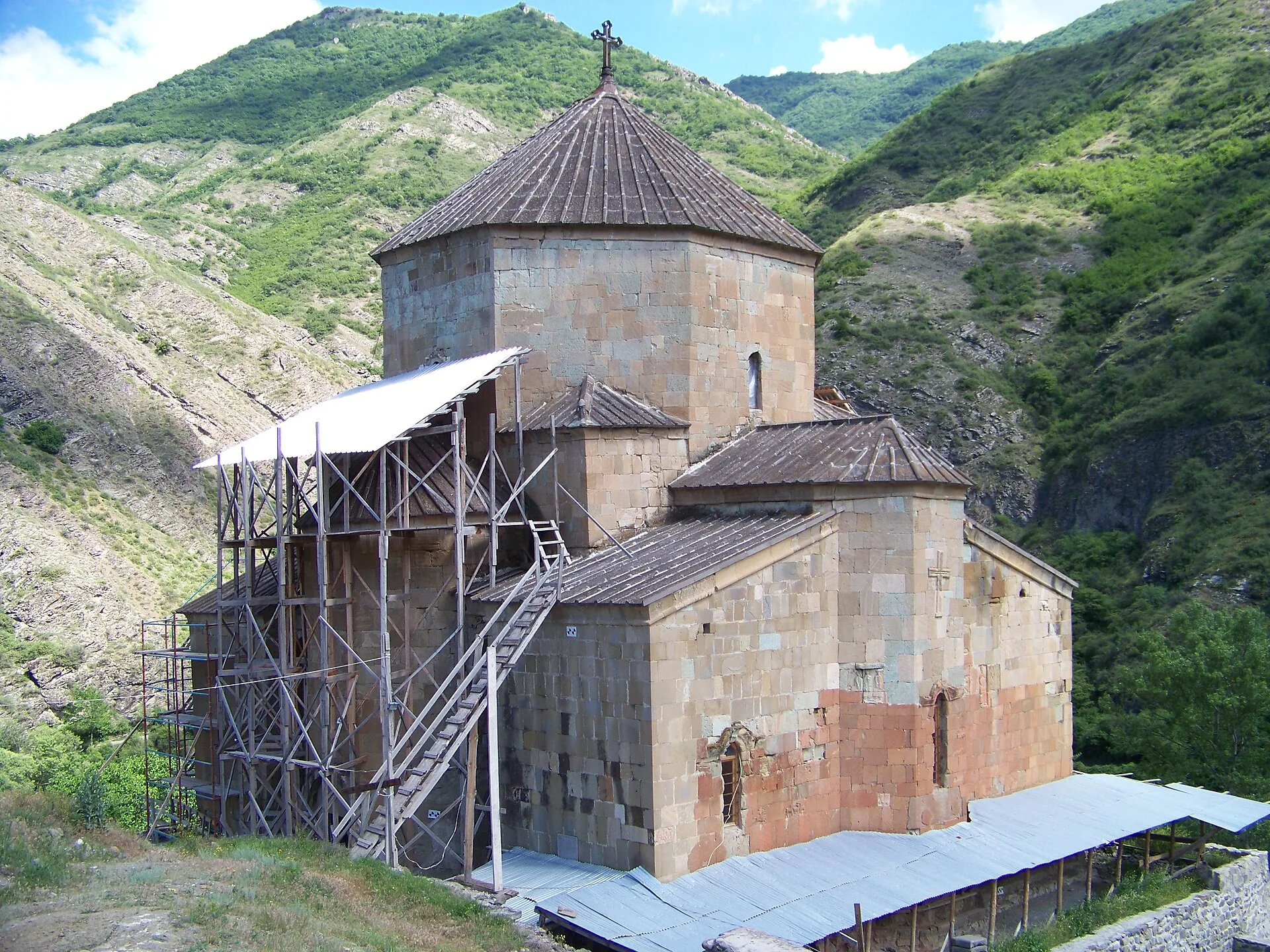
Ateni Sioni stands in the gorge of the Tana river, about ten kilometres south of Gori. The church was built in the early seventh century and is named after Mount Zion in Jerusalem. It is a tetraconch, a building with four apses around the space under the dome, and it closely resembles Jvari at Mtskheta, which is held to be its model. An Armenian inscription on the south façade names Todosak as the builder of this church. Whether he was the original architect or the master who renovated the church in the late tenth century, scholars have not settled.
Outside, the lower courses keep the original reddish stone, while the upper part, after the tenth-century renovation, is faced with greenish-grey slabs. A hunting scene is carved on the west façade: a rider has just loosed an arrow, and it has already pierced a deer's neck. Above the north entrance two deer drink from a round pool. The paintings inside appeared only in the second half of the eleventh century, and at least four artists are thought to have worked on them. The west apse shows the kings and nobles who supported the construction.
The walls of Ateni also serve as an archive. Here is the earliest known inscription in Nuskhuri script, from 835, and the oldest examples of Mkhedruli, the Georgian script in use today, from the 980s. One inscription tells how the caliph's general Bugha defeated Ishaq, the emir of Tbilisi, executed him and on 5 August 853 took and burned Tbilisi. Another records that in the 1060s King Bagrat IV ordered a town to be built at Ateni, and lists its buildings.