The Gurian Republic, 1902–1906
For four years the peasants of Guria lived without the tsarist administration: they held their own courts, called their own assemblies and decided what the schools should teach.
1902
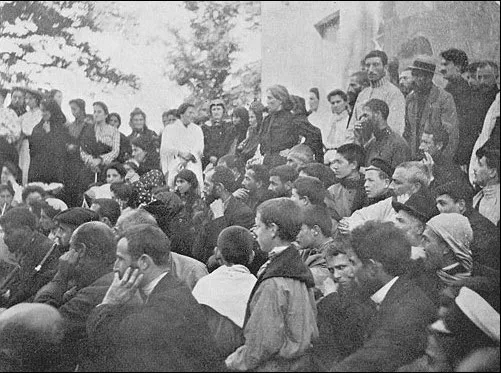
It began in May 1902 in the village of Nigoiti, with a dispute over grazing between the peasants and the local prince Machutadze. About seven hundred people gathered at a meeting and resolved to stop working the prince's land and to stop paying rent. The meeting was organised by the Social Democrat Grigol Uratadze and led by former workers from Batumi. The peasants demanded free grazing, lower rents and an end to payments to the clergy. By the spring of 1903 the movement had spread to half the district, and a year later twenty of the twenty-five rural societies were boycotting the landowners.
The Gurians stopped taking notice of tsarist authority and set up their own. The village assembly was the supreme body and also sat as a court. Households were grouped into circles; each circle elected a tensman, and the tensmen chose a hundredsman. Verdicts were passed by majority vote, and women could vote. The death penalty was kept but never used: the heaviest punishment was a boycott, when the whole village turned away from a person. Yet the movement was not anti-Russian, and the Gurians had no intention of leaving the empire.
On 20 October 1905, at Nasakirali, armed Gurians beat back a detachment of a hundred Cossacks. In January 1906 General Alikhanov-Avarsky was appointed governor, and by mid-February twenty infantry battalions with artillery had been sent into Guria. By mid-March the republic had ceased to exist: hundreds of houses were destroyed and about three hundred people were exiled to Siberia. Many who took part in the movement later became figures of the Democratic Republic of Georgia of 1918–1921.