Shemokmedi: burial place of the Gurieli and a refuge for icons
A monastery on a hill above the Bzhuzhi river, where the princes of Guria gathered sacred objects from lands taken by the Ottomans.
1570
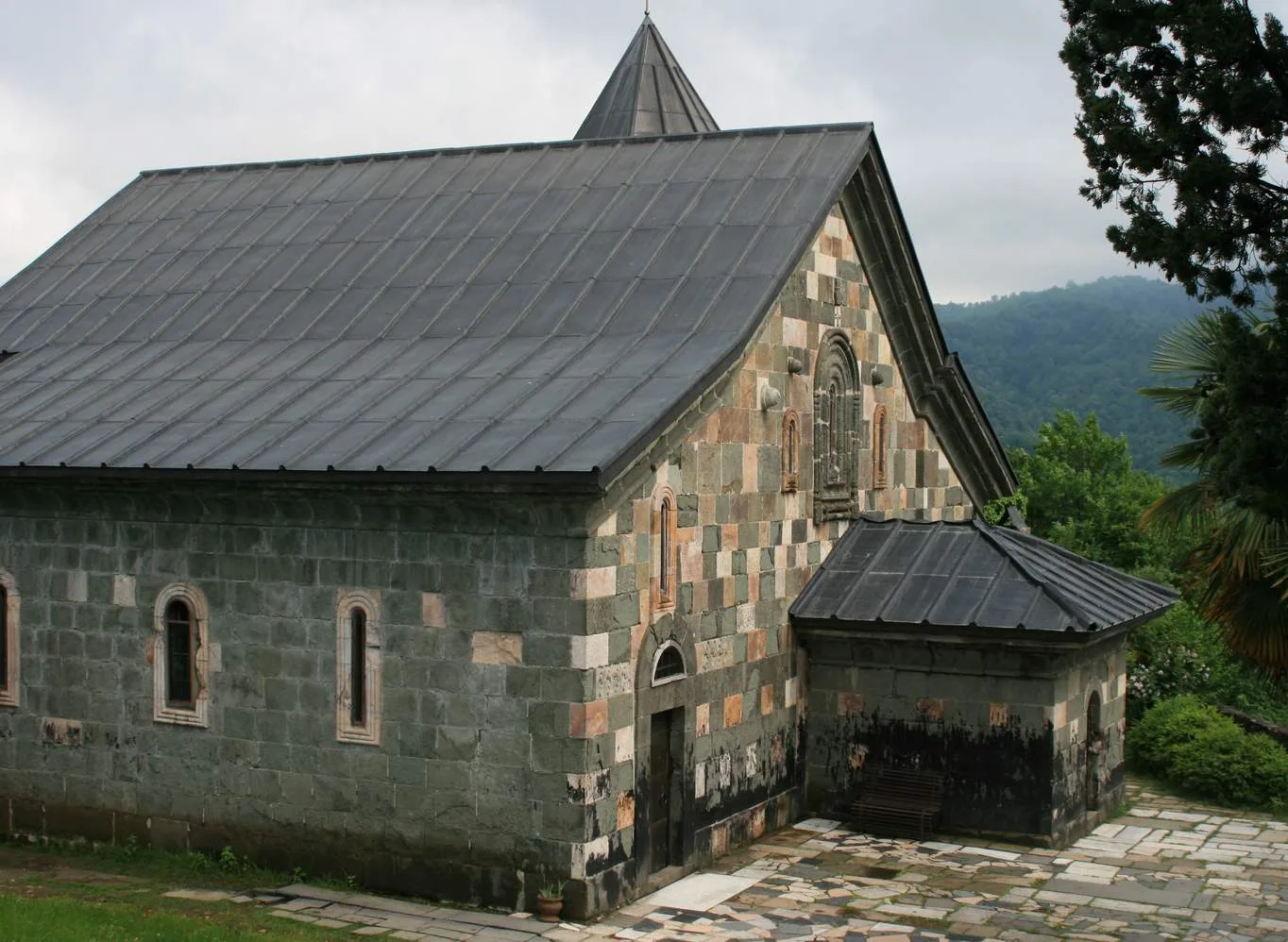
The monastery of Shemokmedi stands on a low hill on the left bank of the Bzhuzhi river, above the village of the same name, seven or eight kilometres south-west of Ozurgeti. It was founded in the fifteenth century as one of the three episcopal sees of the Principality of Guria, alongside Jumati and Khino. The rulers of Guria from the house of Gurieli were buried here too: the tombs of Rostom Gurieli, who died in 1564, and of Mamia III, who died in 1714, survive.
Within the enclosure are two churches and a bell tower. The Church of the Redeemer is a three-nave basilica, ten metres by thirteen, with a floor of white marble. It was once painted throughout, and on the surviving fragments one can make out Prince Mamia II Gurieli and his wife Tinatin. The second church, of the Transfiguration, was built in the sixteenth century by the Gurian ruler Vakhtang Gurieli to house a venerated ninth-century icon of the Transfiguration, brought from the monastery of Zarzma in Ottoman-occupied Samtskhe. That is why the church is also called Zarzma.
Over the centuries Shemokmedi became a repository of church treasures from many Georgian monasteries. In 1820, during the uprising in Guria, Russian troops stormed the monastery and pulled down its fortifications. In 1873 the collection was first described by Dimitri Bakradze, after which the monastery was robbed several times. What survived was catalogued by Nikodim Kondakov in 1889, and since 1924 most of these objects have been kept in the Georgian National Museum.