Cross of St Nino (grapevine cross)
A relic linked to St Nino, through whose preaching Christianity became the state religion of Kartli around 326.
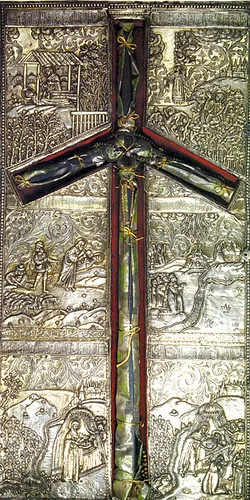
The grapevine cross, with the ends of its crossbar slightly drooping, became the chief symbol of the Georgian Church. Tradition holds that the Virgin gave St Nino a cross made of vine branches, and that Nino, setting out for Iberia in the early 4th century, bound it with her own hair. Her preaching led to the baptism of King Mirian III, and Christianity became the state religion of Kartli.
The relic itself travelled far. Until 541 it was kept at Svetitskhoveli; during the Persian invasions it was taken to Armenia; David the Builder brought it back in 1124. In the troubled 1720s the cross was hidden at Ananuri, and from there Bishop Timothy carried it to Moscow, where it passed into the family of the émigré prince Bakar.
In 1801 Bakar's grandson Giorgi presented the cross to Emperor Alexander I, who returned it to Georgia a year later. Since 1802 the relic has been kept in Sioni Cathedral in Tbilisi. The familiar shape with drooping arms, incidentally, took form only in the early modern period, not in Nino's own time.
Paata Vardanashvili's photograph of 2007 shows not the relic itself but an image of the grapevine cross in the interior of Sioni Cathedral, the very church where the relic is kept. Such crosses are found everywhere in Georgia, from church walls to the small crosses worn at the neck, and each repeats the same story of the vine and the hair.