Tiflis: a 19th-century photograph
Views of old Tiflis under the Russian Empire: sulphur baths, caravanserais and the life of a multi-ethnic city.
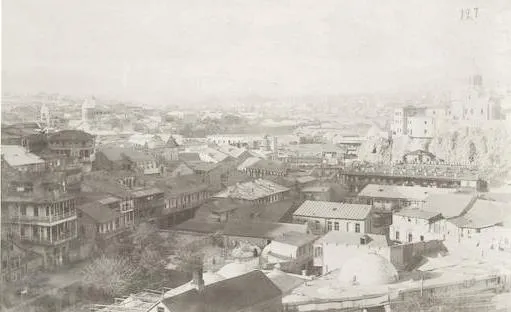
The photograph was taken in the 1870s and is held by the New York Public Library in the collection of George Kennan, the American traveller and journalist who journeyed across the Caucasus. It shows the slope of Mtatsminda with the Church of St David above the roofs, and below, streets labelled Laboratory Street and Bath Street.
Tiflis was then the capital of the whole Russian Caucasus: the viceroy lived here, and roads from St Petersburg, Persia and Turkey converged on it. The old quarters beneath the mountain remained many-tongued. Georgians, Armenians, Persians, Russians and Germans lived side by side, each with their own churches and bazaars, and the sulphur baths of Abanotubani served at once as bathhouse, club and place to close a deal.
The church on the mountain is linked to David of Gareja, one of the Thirteen Assyrian Fathers: tradition says that in the 6th century he lived here in a cell before leaving for the Gareja desert. Hence the mountain is called Mtatsminda, the holy mountain, and the church Mamadaviti, Father David. The present church was built in the 19th century, and as early as 1829 Alexander Griboyedov was buried beside its walls; his grave began the pantheon, officially opened in 1929.
In 1936 Tiflis officially took back its Georgian name, Tbilisi. The photograph comes from a time when the city still remembered itself as Persian and caravan-bound while already becoming imperial and European, and both lives are visible in a single frame.