Vani: gold of ancient Colchis
The Vani archaeological complex in Colchis yielded rich 1st-millennium-BCE gold jewellery, echoing the myth of the Golden Fleece.
Vani lies on a hill in Imereti, in western Georgia, and from the 8th century to the mid-1st century BC it was home to one of the chief cities of ancient Colchis. Systematic excavations began in 1966 under Otar Lordkipanidze and continue to this day. In its late period Vani was a city-sanctuary with temples and altars, resembling the temple communities of Anatolia.
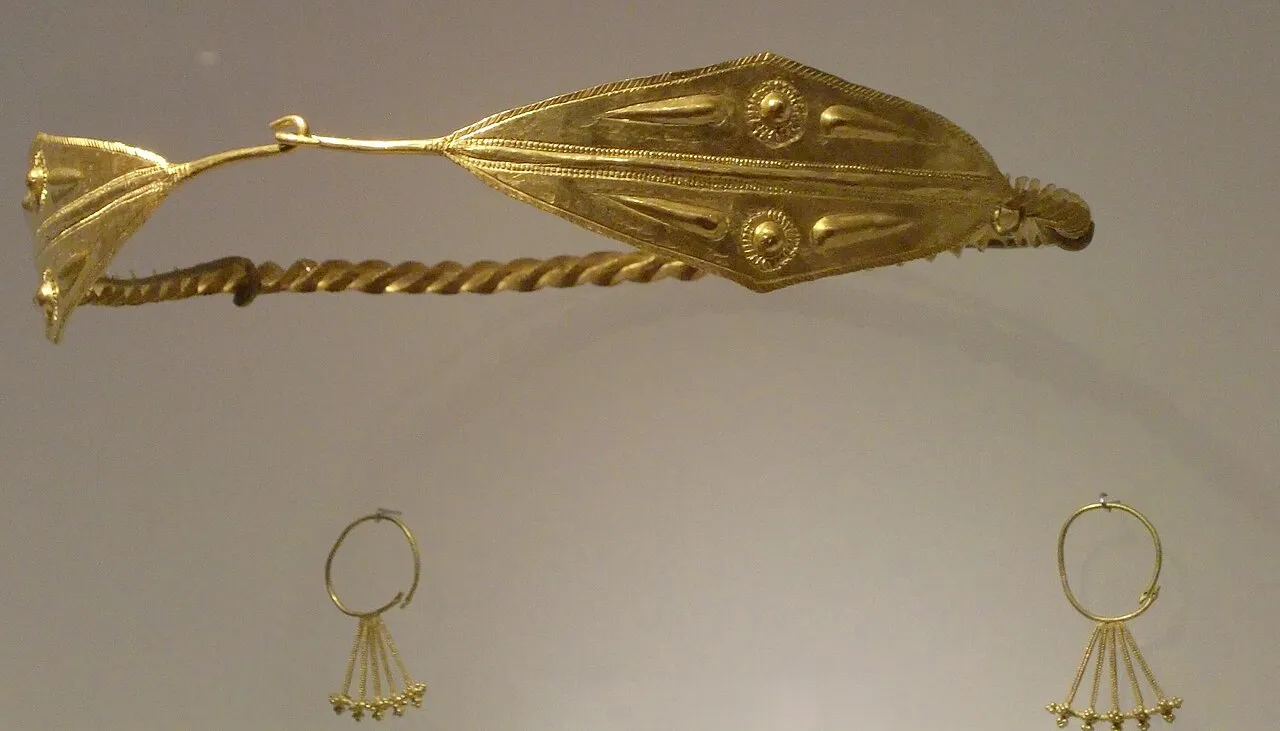
Vani owes its fame to burials of the 5th and 4th centuries BC, in which Colchian nobles were laid to rest with gold. The photograph shows a Colchian gold diadem in the Georgian National Museum. Such diadems were made of rhomboid plaques worked in repoussé with scenes of lions attacking wild boar; they were found in graves 6 and 11 and occur only in Colchis, though the scenes themselves clearly show Near Eastern and Greek influence.
The diadem is so large that it was probably worn over a headdress, perhaps one of cloth. In the second half of the 4th century the rhomboid diadems disappear, replaced by ornaments of pendants in the form of horsemen and birds, but the fine repoussé and granulation of Colchian goldsmiths remain unmistakable.
In the mid-1st century BC the city was sacked, and who destroyed it is still debated, with the armies of Pompey, Pharnaces II or Mithridates of Pergamon all named. The gold of Vani is kept in the Georgian National Museum in Tbilisi and in the museum at Vani itself, and beside it the myth of the Golden Fleece is hard to forget: the land the Argonauts sailed to really did know how to work gold.