Mtskheta: the ancient capital
The ancient capital of Kartli and spiritual heart of Georgia; Svetitskhoveli Cathedral and nearby monuments form a UNESCO World Heritage site.
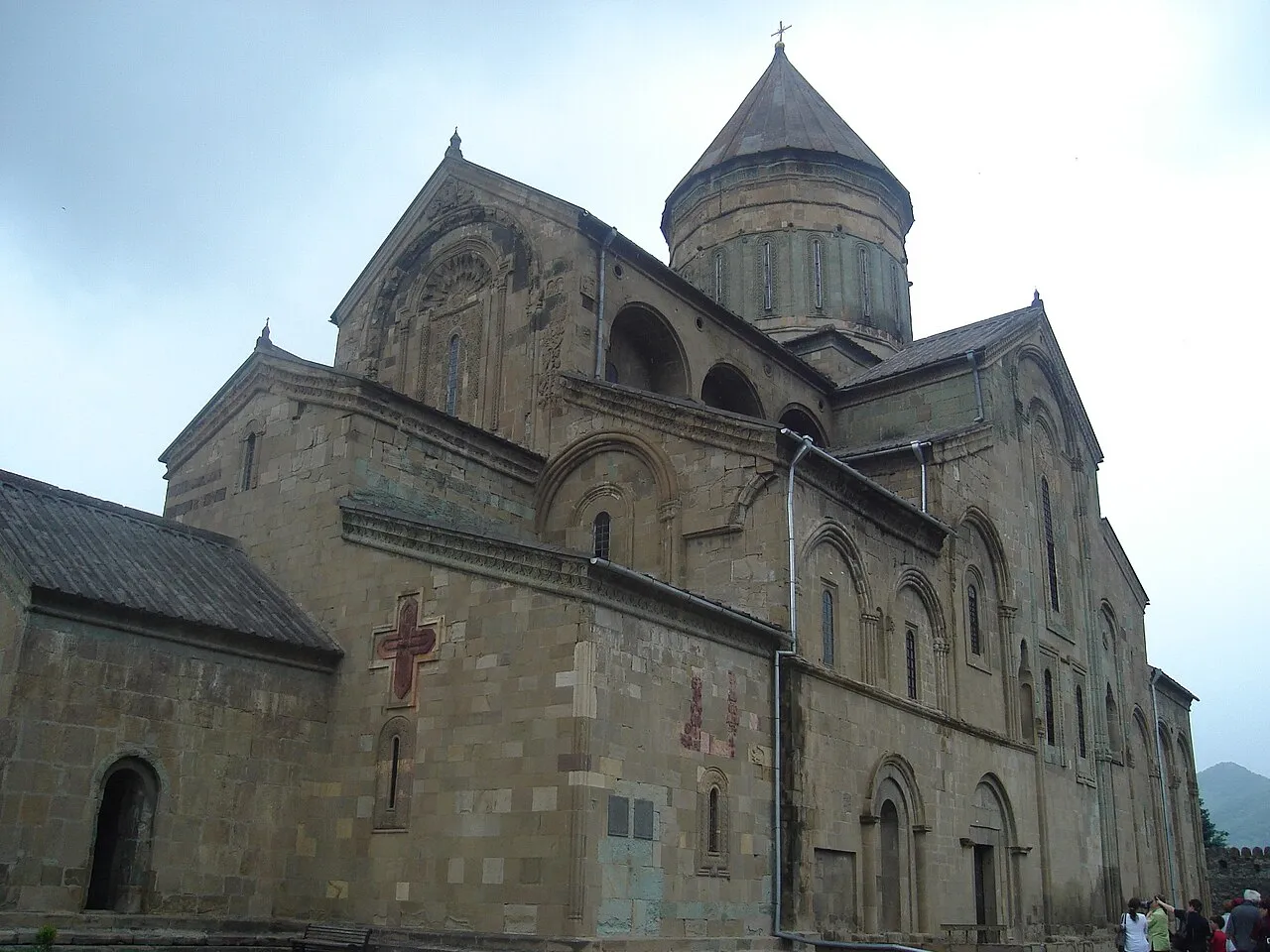
Mtskheta lies where the Aragvi meets the Mtkvari, a little over twenty kilometres from Tbilisi, and for many centuries it was the capital of Kartli. The kings of Iberia ruled from here, King Mirian III accepted Christianity here in the 4th century, and even after the court moved to Tbilisi in the 6th century, Mtskheta remained the country's spiritual capital.
The photograph shows Svetitskhoveli Cathedral. The present building was raised in 1010–1029 by the architect Arsukisdze for Catholicos Melchizedek, and before it the site held a 4th-century wooden church built under Mirian and a 5th-century basilica of Vakhtang Gorgasali. A hand carved on the north façade, with an inscription naming the architect, gave rise to the legend that the master's hand was cut off for work too beautiful. There is no historical evidence for it.
The name itself means the life-giving pillar. According to the hagiography, Elioz brought Christ's robe from Jerusalem; his sister Sidonia died clasping it to her breast and was buried with it. A cedar grew from her grave, seven columns were hewn from it for the first church, and the seventh rose into the air of its own accord. Kings are buried beneath the vaults, among them Vakhtang Gorgasali, Erekle II and George XII, the last king of Kartli-Kakheti.
The stone wall with towers around the cathedral was built by Erekle II in 1787. Since 1994 Svetitskhoveli, the Jvari Monastery and Samtavro have been on the UNESCO World Heritage list as the Historical Monuments of Mtskheta. In the town where the country's history began, that history still feels less like the past than like a place.