George the Hagiorite
Theologian, translator, abbot of Iviron
1009–1065
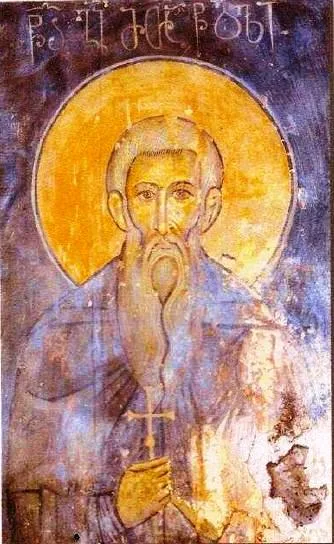
George the Hagiorite (1009–1065), that is, “of the Holy Mountain”, was born in Trialeti into the noble family of Jacob, an envoy whom Bagrat III sent to Iran. At seven he was given to the monastery of Tadzrisi, three years later moved to Khakhuli, and around 1022 was sent to Constantinople, where he learned Greek and studied Byzantine theology in depth. Returning in 1034, he took monastic vows at Khakhuli, made a pilgrimage to Jerusalem and studied under George the Recluse on the Black Mountain near Antioch.
In 1040 he came to Iviron, and in 1044 he became its abbot and renewed the monastery. George made new translations of the Gospels and the Psalter and of works by Basil the Great, Gregory of Nyssa, John of Damascus and many others, corrected the translations of Euthymius and wrote “The Lives of John and Euthymius”, his chief original work. In Antioch, before Patriarch Theodosius, he defended the autocephaly of the Georgian Church, citing the preaching of the Apostle Andrew in Georgia. In 1057, at the invitation of the king, then Bagrat IV, he returned home for five years and carried out church reforms; on his way back he died in Athens in the summer of 1065 and was buried at Iviron.
George's name is also linked to the story of the song “Evening Bells”. According to Kalinovsky, writing in 1885 in his book “Where Is the Truth? A History of the Iviron Monastery on Athos”, the words of this song are a translation of a church hymn by George the Hagiorite whose manuscript was kept at the Gelati monastery. In Russian the song is known from Ivan Kozlov's poem of 1828, a version of Thomas Moore. In 1898 the historian of Georgian literature Alexander Khakhanov repeated the same view. The Georgian Church venerates George as a saint, his feast on 27 June in the old calendar.