David Kakabadze
Painter
1889–1952
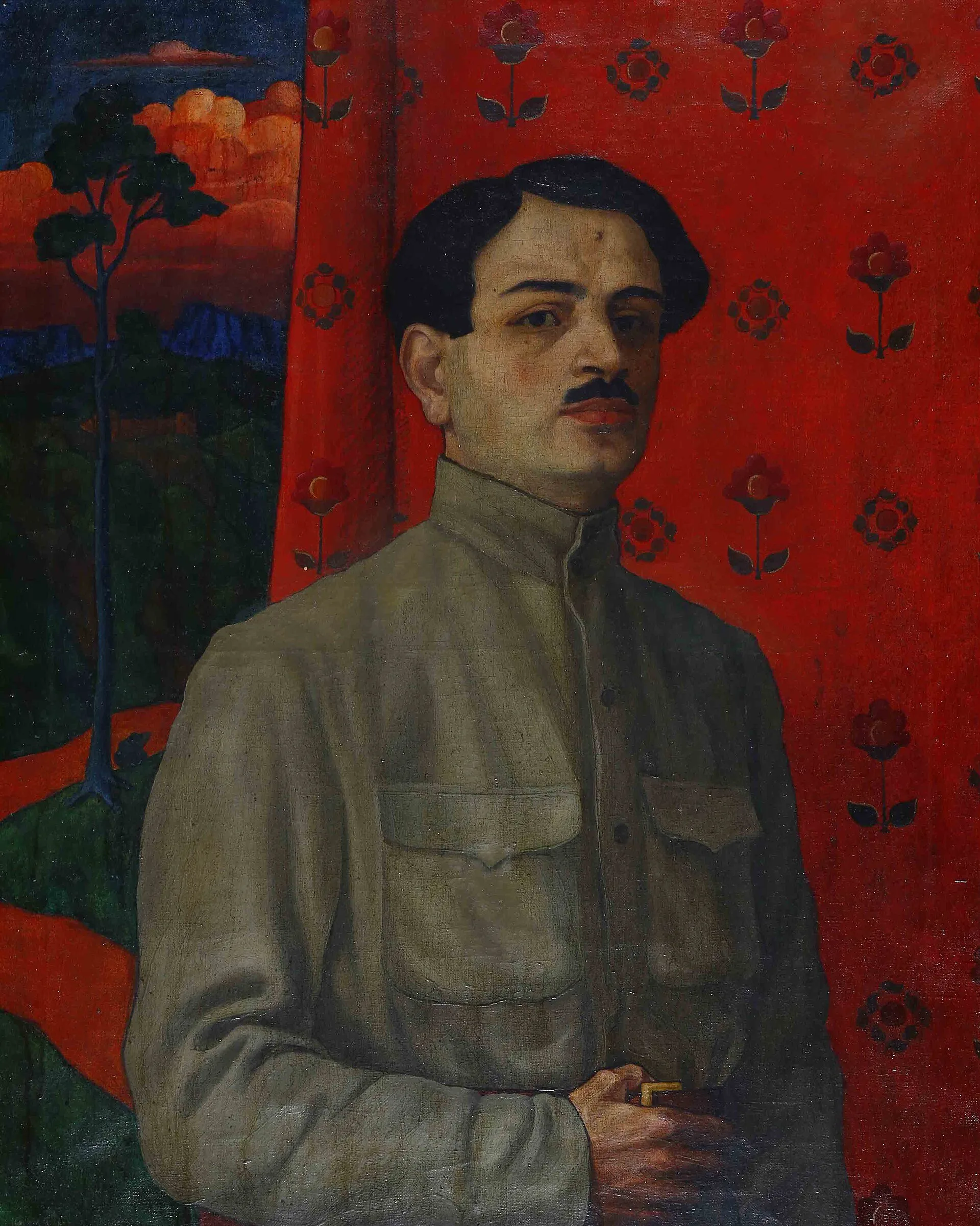
David Kakabadze was born on 20 August 1889 in Didi Kukhi, a village near Khoni in Imereti, into a poor peasant family. Local patrons paid for his education, and he graduated in natural sciences from St Petersburg University while attending the studio of the painter Lev Dmitriev-Kavkazsky until 1915. Science and art ran side by side for the rest of his life. In St Petersburg he painted his first self-portraits, began to study old Georgian art, and in 1914 signed, together with Pavel Filonov, the manifesto of the "Made Paintings" group. His elder brother Sargis became a well-known historian.
In 1918 he returned to Georgia and painted a cycle of Imeretian landscapes: not a view from a window but his native land, built from fields, hills and trees into a strict, almost carpet-like pattern. From the same year comes "Imereti, My Mother", in which a woman sits spinning against those hills; her figure is printed today on the back of the ten-lari note. From 1919 to 1927 he lived in Paris, showed at the Salon des Indépendants and together with Lado Gudiashvili and Shalva Kikodze, and exhibited in America. There he turned to non-objective art and built pictures from metal, mirror glass and lenses, and in 1923 he designed a camera that gave the illusion of depth on the screen and patented it in several European countries.
After his return Kote Marjanishvili invited him to his new theatre in Kutaisi, and Kakabadze became its first designer; in 1930 he was the art director of Mikheil Kalatozishvili's film "Salt for Svanetia". From 1928 to 1948 he was a professor at the Tbilisi Academy of Arts and painted Imereti anew, now with power stations and quarries. In 1948 he was dismissed for "formalism". He died in Tbilisi on 10 May 1952 and is buried in the Didube Pantheon. Today a picture gallery in Kutaisi and the Kakabadze Brothers Street in Tbilisi bear his name, and in 2018 Georgian Post issued a stamp with his self-portrait.