Kartlos
Legendary forefather of the Georgians
tradition
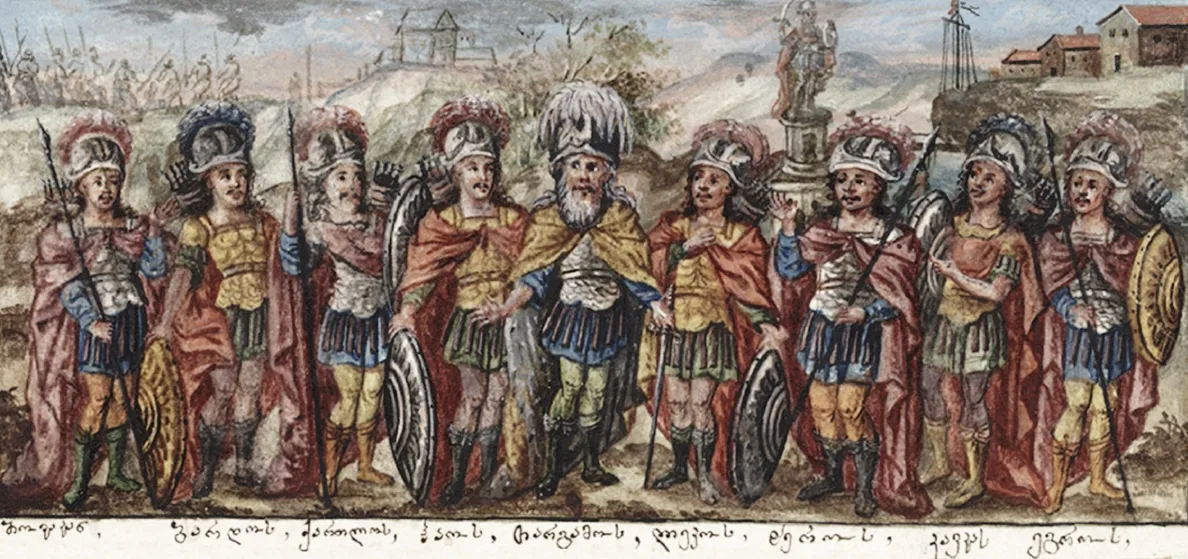
In Georgian tradition Kartlos is the forefather of all Georgians, or more precisely of the people of Kartli, ancient Iberia. The medieval chronicle “Kartlis Tskhovreba” relates that he was the second son of Targamos, a great-grandson of Japheth, and that after the fall of the Tower of Babel Targamos received the Caucasus and divided it among his eight sons. Each became the ancestor of a people: Haos of the Armenians, Bardos and Movakan of the Caucasian Albanians, Lekos of the Lezgins, Heros of the Heretians, Kavkas of the North Caucasian highlanders, Egros of the people of Egrisi, and Kartlos of the Kartlians.
Kartlos united his people and founded the land of Kartli, and according to tradition he settled on the mountain later called Armazi. He had many sons: the eldest, Mtskhetos, gave his name to Mtskheta, and from the names of others, Gardabos, Kakhos, Kukhos, Uplos and Javakhos, tradition derived the names of Georgian lands and towns. Together with his brothers he fought the giant Nebrot, that is, the biblical Nimrod, to free himself from his rule.
Historians see in this account not history but a medieval attempt to link the ancestors of the Georgians to biblical genealogies. Kartlos first appears in a chronicle dated to the eleventh century and attributed to Leonti Mroveli, though the tradition itself may be older, from around the eighth century. Ivane Javakhishvili regarded the myth of Kartlos and his brothers as a political tool that justified the unification of the Georgian lands. Yet the name lived on: tradition derives from him both the name Kartli and the word “kartveli” with which Georgians call themselves.