Dimitri Kipiani
Prince, publicist, writer and translator
1814–1887
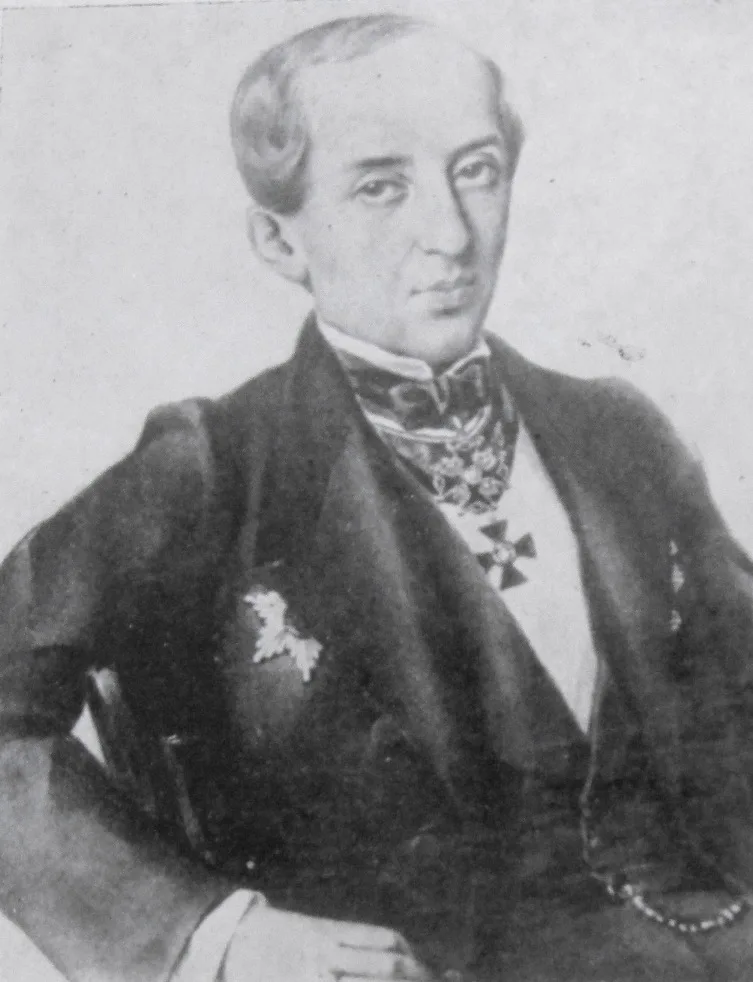
Prince Dimitri Kipiani (1814–1887) was born in the village of Mereti near Gori and in 1830 graduated from the Tiflis School of Nobility, where he later taught. For taking part in the plot of 1832 against Russian rule he was exiled to Vologda, but in 1837 he was allowed to return, and until 1864 he served in the viceroy's chancellery. He became the recognised voice of the liberal nobility, served as marshal of the nobility of the Tiflis and later the Kutaisi governorate, and from 1876 to 1879 was mayor of Tiflis.
Kipiani did much for education: he was among the founders of the Nobility Bank, the Society for the Spreading of Literacy among Georgians and the Georgian Dramatic Society, and helped collect and preserve Georgian church chant. He was the first to translate Shakespeare into Georgian and wrote a “Modern Georgian Grammar”, a book not only for teaching but also political, since the dispute over the language was growing ever sharper. He was convinced that real progress is possible only for a nation that thinks and speaks in its native language, and he worked closely with Ilia Chavchavadze and Akaki Tsereteli.
In 1886 the seminarian Laghiashvili killed Chudetsky, rector of the Tiflis Seminary, who had called Georgian “a language for dogs”, and the Exarch of Georgia, Pavel, anathematised the whole Georgian nation in response. Kipiani wrote to him that, if the rumours were true, the only way to save the honour of his office was for the insulter to leave the insulted country at once. On the order of Emperor Alexander III he was removed and exiled to Stavropol, where in 1887 he was murdered in unexplained circumstances. He was buried in the Mtatsminda Pantheon, his house museum stands in Kvishkheti, and in 2007 the Georgian Church canonised him.